

Thursday 3 April
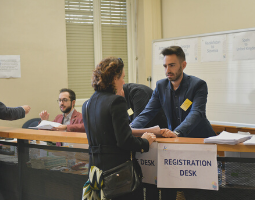
Registration - informal networking
Pre conference introductory session to the EPARM and its work
Presentation Projects from EAMT
Introduction – Margus Pärtlas (Vice-Rector for Academic Affairs and Research EAMT)
How to share the ardor? Conveying complex musical structures to unprepared listener through the animated score on the example of Eduard Tubin’s first symphony – Mihhail Gerts
The goal of our artistic research project is to create an animation of the first movement of Eduard Tubin’s Symphony No. 1, in which the visualisation of musical elements would support the understanding of the unfolding musical structure in real-time by a recipient without prior musical knowledge. Having started this project in November 2024 we have by now developed the method of visualising the main thematic aspects of the composition and are currently working on precise timing of the series of drawings according to the formal development of the composition. In my presentation I will introduce our methods, current state of the research and our final goal, which is a new concert format, combining a live orchestral performance with the animation depicting the construction of the musical form in real time.
Historical Intruder in Performance. The Use of Accordion Technology in Harpsichord Repertoire –Momir Novakovic
Although it is considered by study curricula and repertoire practices as a keyboard instrument, accordion is first of all an aerophone instrument. This characteristic makes the interpretation of harpsichord repertoire very different, and requires further understanding of the period as well as some paradigm shifts. The goal of my research is to investigate and exploit the technological complexity of accordion, and by consequence its characteristic techniques in performance, in the historically informed interpretation of baroque music for harpsichord.
Opening event
Keynote speech - Valorising Artistic Research: Whose Responsibility Is It? - Heloisa Amaral
A reflection on paralysis, pressure, and the unfinished in artistic research – Heloisa Amaral
Moderated by Paul Craenen (EPARM WG)
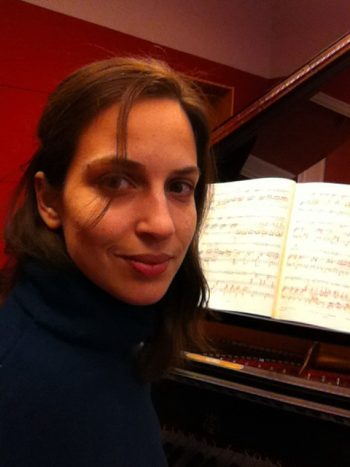
What does it mean to valorise artistic research in music, and who carries that responsibility? As an artist researcher, music festival director, teacher and listener, I find myself navigating different expectations across these roles. There is a common assumption that artistic research must open up, step out of the confines of the academic world, reach broader audiences, demonstrate relevance. But is it always the responsibility of artist-researchers to make that move? I will reflect on how different forms of value are negotiated in artistic research, and how the needs and expectations of artists, academia, presenting institutions, audiences and funders meet, shift or come into tension with one another.
Heloisa Amaral is a Brazilian pianist, curator, and researcher known for her work at the intersection of performance, contemporary music, and artistic research. She lectures in curatorial practices at the Royal Conservatoire The Hague and holds a doctorate in artistic research from the Orpheus Institute and Leiden University. As a performer, Amaral plays solo and with Ensemble neoN and Duo Hellqvist/Amaral. Since 2023, she has been the director of Ultima Oslo Contemporary Music Festival.
Coffee break
Research Presentations I (click to check abstract and bio)
Break to allow room change
Research Presentations II (click to check abstract and bio)
Open Space - Themed discussion chaired by Stephen Broad (EPARM WG)
Concert
Reception
Friday 4 April
Information Forum
Coffee Break + Information Market
Round Table
This participatory round table marks the first step in a new initiative for EPARM. Building on the work of RappLab and REACT, two recently concluded and complementary Erasmus+ Strategic Partnerships, we will begin to set the agenda for a programme of work around Artistic Research Education (ARE). What are, should or could be our priorities for meaningful ARE in the first and second cycles of Higher Music Education? How can we work together to enhance the ARE we offer to third cycle students? And what are the priorities for supporting the continuing development of Artistic Researchers, doctoral supervisors, and members of the wider artistic communities of our institutions?
The round table brings together members of the RappLab and REACT teams with members of the EPARM working group to share experience and views. Join us, and help to set the agenda.
Panellists:
Anna Maria Bordin (EPARM WG member, Conservatorio Statale di Musica “Giuseppe Verdi” di Torino)
Stefan Gies (AEC Senior Advisor)
Wei-Ya Lin (EPARM WG member, mdw – University of Music and Performing Arts in Vienna)
Stefan Östersjö (REACT project, Luleå University of Technology -School of Music in Pitea)
Theodore Parker (RAPP Lab, Estonian Academy of Music and Theatre)
Facilitator:
Stephen Broad (EPARM WG chair, Royal Conservatoire of Scotland)