Advocacy – The Culture Compass

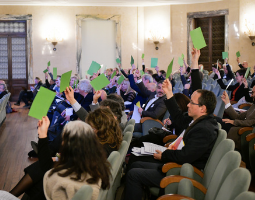
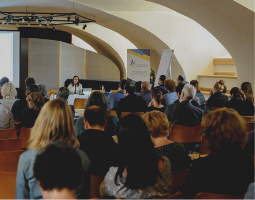
The Culture Compass was presented by EU Commissioner Glenn Micallef on 12th November at the LUCA School of Arts, with a range of cultural networks present, among them AEC.
The Culture Compass to which AEC – in a process led by Culture Action Europe – provided input, responds to current geopolitical, social, and technological changes and offers a structured framework to embed culture more firmly in EU policy and funding. The strategy positions culture as both a fundamental public good and a strategic asset for democracy, cohesion, innovation, and Europe’s global role.
Recognising the potential of culture to unite, the Compass is also accompanied by a draft Joint Declaration to be agreed by the European Parliament, the Council and the Commission. Furthermore, it introduces a new governance and monitoring architecture, including a State of Culture Report, an EU cultural data hub, and a structured dialogue with cultural stakeholders.
Vision and Overall Structure of the Culture Compass
The overarching idea is framed as “Europe for Culture, Culture for Europe”. Moreover, the Compass is structured around four key directions supported by a dedicated chapter on investment tools. This structure functions like concentric circles, beginning with values and rights and expanding outward to people, competitiveness and cohesion, and international cultural relations.
The Four Structural Pillars
- Values and Rights: Upholding cultural rights, artistic freedom, and cultural and linguistic diversity.
- Artists and People: Improving working conditions, mobility, youth participation, and strengthening the interconnection between culture and education.
- Competitiveness, Resilience, Cohesion: Harnessing digital transformation, cultural heritage, regional development, climate action, and sustainable tourism.
- International Cultural Relations: Scaling up cultural diplomacy, partnerships, and cooperation in enlargement contexts and multilateral fora.
A final section focuses on funding, including the future AgoraEU framework, mainstreaming across EU instruments, and leveraging private capital.
Pillar 1: Values and Cultural Rights
This section affirms that democracy, freedom, diversity, and equality rely on cultures where artistic expression can flourish. The Commission highlights threats such as censorship, intimidation, and self-censorship and among other things commits to:
- Monitoring artistic freedom through the State of Culture Report.
- Developing “safe havens” for at-risk or displaced artists.
- Strengthening policies that protect minority languages, cultural diversity, and the discoverability of European content online.
Pillar 2: Empowering Artists and Supporting People
This section focuses on the conditions needed for cultural work and participation to thrive. Better Working conditions will be supported by an EU Artists’ Charter (non-binding but politically significant) and to supporting tools that strengthen understanding of artists’ rights and IP. The proposed Fair Labour Mobility Package will support cross-border mobility, and a Youth Cultural Ambassadors Network will bring younger voices into cultural policy.
Highlight: The strong emphasis on culture and education
The Compass explicitly states that culture and education are deeply interlinked and mutually reinforcing. It recognises that cultural participation and arts education:
- strengthen creative and critical skills;
- improve civic engagement, communication, empathy, and tolerance;
- contribute to students’ well-being;
- expand access to cultural institutions and lifelong learning opportunities.
The document stresses that arts and cultural education must be strengthened and better resourced, noting that they are often marginalised or underfunded in national education systems. To address this, the Commission will among other things:
- promote cross-sector cooperation between culture and education policy;
- foster partnerships among schools, artists, cultural institutions, formal and non-formal education providers;
- develop a peer-learning project to enhance civic engagement and democratic citizenship through culture within and around schools;
The AEC recognises that this is one of the most explicit and structurally integrated culture-education links ever included in an EU culture strategy, and sees a potential for many initiatives.
Pillar 3: Culture, Competitiveness, Resilience, Cohesion
This pillar highlights culture’s economic and societal impact, from innovation to tourism, and outlines actions to future-proof the sector.
Digital and AI transformation:
The Commission acknowledges AI’s potential for cultural innovation – e.g., immersive media, digital twins of heritage sites – while recognising risks for copyright, fairness, and diversity. A dedicated AI Strategy for Cultural and Creative Sectors will be developed, alongside a review of copyright rules and transparency requirements for AI-generated content.
Culture and the green transition:
Culture is recognised as a driver of behavioural change and sustainability. The Commission will foster collaboration between cultural and environmental stakeholders and launch a European R&I Partnership for Resilient Cultural Heritage.
Pillar 4: International Cultural Relations
Culture is positioned as a strategic instrument for peace, global cooperation, and Europe’s credibility in a contested information environment. The Commission commits to:
- updating the EU Strategy for International Cultural Relations;
- strengthening cooperation in enlargement and neighbourhood regions (including a new EU4Culture phase and a Euro-Med initiative);
Investment and Funding Architecture
The final section emphasises that the Compass can only succeed with strong and coherent investment. It proposes:
- Creative Europe / AgoraEU as the main dedicated EU funding framework, with a simplified architecture and increased budget.
- Mainstreaming culture across major EU programmes – Horizon Europe, the European Competitiveness Fund, cohesion policy, Global Europe
- Developing new financial instruments to leverage private capital, including public–private partnerships and innovative investment tools with the European Investment Fund .
AEC concludes
The Culture Compass represents the EU’s most ambitious cultural policy framework to date. It centres culture as a cornerstone of European democracy, well-being, innovation, resilience, and global engagement. Crucially, it introduces robust governance tools: data hub, monitoring and structured dialogue that can give culture greater policy weight across institutions.
Especially happy is AEC with the fact that the strategy places unprecedented emphasis on the connection between culture and education. The ambition is to strengthen the provision of arts and cultural education must be strengthened and to reach that goal the Commission will promote stronger cross-sector cooperation between culture and education policies.
Although there are many positive elements in the Culture Compass, AEC will continue its call for 2% of the next MFF to be dedicated to culture. Finally, AEC urges the Commission to raise its level of ambition and work towards a dedicated Artistic Freedom Act, just as Higher Music Education Institutions can only contribute their full potential if it is fully integrated into the notion of STEM education.