AEC at the NASM Annual Meeting 2025
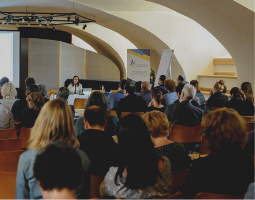
AEC maintains regular contact with its partners around the world, and at the end of November AEC Director Finn Schumacker attended the Annual Meeting of the National Association of Schools of Music, which took place in Orlando, Florida.
Inspiring keynote by Roland Crutcher
Addressing the theme of the Annual Meeting, The Essentiality of Music, keynote speaker Ronald A. Crutcher drew on his impressive career serving in senior leading positions at American universities, symphony orchestras and national organisations across the country. As a cellist, he was a member of the Klemperer Trio for almost 40 years and his thematic memoir I Had No Idea You Were Black: Navigating Race on the Road to Leadership, was published in February 2021.
Crutcher spoke about the need for a shift in mindset within the music world. It is not enough simply to play an instrument or merely to entertain. Research has long shown that music is closely connected to human emotional life and possesses immense power. Music brings us together across races and linguistic barriers, and if music were to disappear, we would lose an essential part of our identity and history.
Therefore, we must teach students to become communicators of music in all its inherent values. We must teach them to tell stories — their own experiences with music, as well as the experiences they have shared with parents, grandparents, and friends.
As leaders within a higher education institution, we have an obligation to help shape the engaged citizens of the future. Democracy does not function by itself; it must be practised. This is particularly evident today, as people increasingly speak within bubbles with others they agree with. We have lost the ability to have difficult conversations. This is something we must relearn. Our most important task as leaders is to help strengthen the voice of education in society.
A global concern: Music Teacher Shortage
Teacher shortages have become a global challenge, and this also applies to music educators. The consequences are that more and more children and young people lack access to music education from an early age, which negatively affects not only the individual children and young people, but also the cohesion of the entire musical ecosystem.
Signs of teacher shortages can be observed everywhere, caused among other things by high attrition rates after graduation, poor working conditions in general, and a widespread lack of societal recognition for teachers’ work. The challenge is complex, and therefore there are no simple quick fixes. Instead, action is needed on many levels, which was the starting point for discussions at the NASM Annual Meeting.
AEC and NASM are working together to find solutions to this challenge, and this is why NASM President Tayloe Harding was a guest at the AEC Congress in Salzburg, where Prof. Isolde Malmberg from mdw and the TEAM project also participated. Likewise, AEC Director Finn Schumacker contributed to the discussions during the NASM Annual Meeting.
While the data landscape in Europe does not cover all countries, the US has comprehensive figures across states. A large foundation-funded study presented by Lynn Tuttle from the American String Teachers Association highlighted, among other things, that up to four million children and young people in the US have no access at all to music education. Many music teachers leave the profession early because they no longer feel able to meet the increasing demands of classroom management resulting from greater diversity and growing groups of pupils with diagnoses requiring special support.
In both the European and American sessions, there was agreement that a wide range of measures must be considered. Among these are:
Teacher Education:
- Alternative career pathways and targeted CPD (Continuing Professional Development)
• Futureproofing of curricula in teacher training programmes
• Expanding the capacity and funding of teacher education programmes
• Greater student involvement
In Schools:
- Strengthening collaboration models among teachers
• Creating professional learning communities
• Establishing mentoring schemes
Advocacy at Multiple Levels:
- Creating a new narrative about the attractiveness of the teaching profession
• Regaining lost resources by defining the positive impact of music more broadly
A valuable collaboration
With more than 600 members, the NASM Annual Meeting is a major event, grounded in the organisation’s core mission: the accreditation of its members’ institutions and programmes. This is reflected in the programme content, which primarily offers various forms of training and preparation for the accreditation process.
Alongside the keynote and the discussions on the shortage of music teachers, a number of other interesting sessions were offered, including presentations of new working methods involving AI, competitions, curriculum design, and strategic planning. NASM’s major data project, HEADS, enables music administrators to find relevant data across the NASM membership on enrollment trends, market demand, faculty efficiency, financial costs, and the like.
In this way the collaboration between AEC and NASM contributes with new knowledge that flows between the organisations, even between the events and AEC is grateful for the longstanding relationship that will continue to inspire.