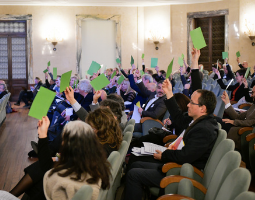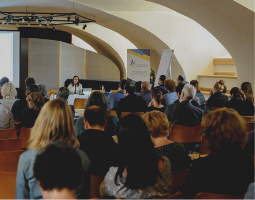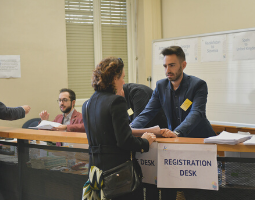
On 27 March 2026, the AEC Comms Exchange held its second “Institutional Deep Dive” focused on the structural relationship between internal engagement and external visibility. Aligned with the AEC Strategy 2030, the session framed communication as a strategic instrument essential for institutional leadership and influence rather than a mere support function.
A Note on Confidentiality: The AEC Comms Exchange is designed as a secure, peer-to-peer “safe space” where professionals can share sensitive institutional hurdles and “honest challenges” without reservation. To respect the privacy of our members and the nuances of their internal operations, the following summary captures the general strategic takeaways and public case studies only, representing a partial recap of the full, confidential discussion.
Strategic Alignment: Shifting from “Support” to “System”
A central takeaway from the discussion was the need to move away from “reverse-engineering” communication. Participants noted that in arts institutions, projects often stem from artistic enthusiasm but lack clear objectives, leading to fragmented messaging. To be effective, communication must be integrated at the start of the project lifecycle to ensure quality and sustainable outputs.
Institutional Case Studies: Successes and Hurdles
The meeting featured three distinct institutional perspectives on managing the “1 Success & 1 Challenge” format:
Royal Conservatoire The Hague (Kristin Poot)
-
External Strategy: Used a 200th-anniversary narrative (“All the world’s our stage”) to secure media visibility and advocate for the value of music education.
-
Internal Strategy: Created a “visual timeline” within the building to make institutional history engaging for students.
-
The Challenge: Managing the tension between global recruitment goals and the civic responsibility to connect with local audiences.
ESMUC, Barcelona (Montserrat Urpí Cámara)
-
External Strategy: Built a recognisable identity by showcasing authentic daily activity—academic life, research, and performances—rather than “inventing” a brand.
-
Internal Strategy: Found higher engagement when internal updates were tied to concrete opportunities like international mobility.
-
The Challenge: Overcoming “information fatigue” among faculty whose primary focus remains on teaching and artistic practice.
ANMGD, Cluj-Napoca (Cristina Eleonora Pascu)
-
External Strategy: Achieved rapid audience growth for specific projects through community-driven dissemination and personal networks.
-
Internal Strategy: Successfully mobilised technical teams for complex interdisciplinary formats.
-
The Challenge: Managing role overlap in small teams where one person handles coordination, organisation, and communication simultaneously
Operational Insights for Communication Officers
The final Q&A and group discussion highlighted several tactical approaches to managing high-volume environments:
-
Proactive Scanning: Communication teams should “scan ahead” for upcoming projects to set communication frameworks before production begins.
-
Decentralised Frameworks: Rather than attempting to control every institutional voice, departments should create “shared frames” that allow for diversity while maintaining brand recognition.
-
Prioritisation through Objectives: When faced with overflowing event calendars (sometimes exceeding 400 events per year), institutions must prioritise based on strategic objectives rather than trying to cover everything equally.
-
Post-Event Evaluation: The group identified a common lack of post-event monitoring; consistent evaluation is necessary to improve future strategies and impact tracking.
Thank you
A sincere thank you to our speakers: Kirstin, Montserrat, and Cristina, for the generosity and time they invested in preparing such transparent, high-quality testimonies. We also want to thank all the participants who joined the session; your active engagement and willingness to share your own “raw realities” are what make this peer-to-peer network so valuable.
Next Steps
The AEC Comms Exchange remains a dedicated space for communication staff and administrators to share the “raw reality” of their roles in confidence.
The next meeting will take place before the summer, most likely in early June 2026.
This session is open to all members of the AEC Network. To receive the meeting link and join the discussion, please contact the AEC Communication Manager, Alessandra Callegari, at alessandracallegari@aec-music.eu.