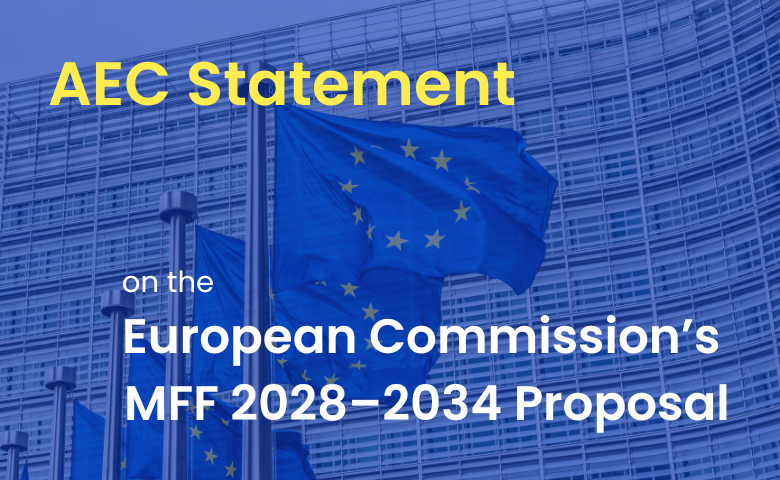
On 16 July 2025, the European Commission presented its proposal for the most ambitious Multiannual Financial Framework (MFF) to date, amounting to nearly €2 trillion for the period 2028–2034. This budget reinforces the EU’s recognition of education, research, and culture as strategic priorities and essential foundations for Europe’s prosperity, resilience, and democratic values, and it offers both opportunities and questions for the Higher Music Education (HME) sector.
The Association Européenne des Conservatoires, Académies de Musique et Musikhochschulen (AEC) welcomes the European Commission’s proposal for the next MFF, particularly the decision to maintain the programmes Erasmus+, Horizon Europe, and Creative Europe.
Creative Europe (AgoraEU): Investing in Europe’s Cultural Future
AEC welcomes the creation of the AgoraEU programme and the proposed €8.6 billion allocation, which merges and doubles the funding previously available under Creative Europe and the Citizens, Equality, Rights and Values (CERV) programme. In particular, the Creative Europe – Culture strand, with a proposed budget of €1.8 billion, preserves core funding schemes that support HME institutions – such as cross-border artistic cooperation, cultural innovation, and sectoral capacity building.
The proposed structure and ambitions of AgoraEU – particularly its focus on intergenerational fairness, cross-sectoral access, and programme simplification – are positive. However, AEC stresses that the proposed funding represents only the minimum required to sustain and further develop Europe’s cultural sector. The cultural and creative sectors continue to face structural challenges and require robust investment. AEC therefore urges policymakers to increase the budget for the Culture strand during the negotiation phase and to ensure its continued autonomy, visibility, and sectoral inclusivity.
Erasmus+: Enhancing Mobility and Cooperation in Higher Music Education
AEC strongly supports the proposed €40.8 billion allocation to Erasmus+, which represents a significant 50% increase compared to the 2021–2027 budget. The programme is one of the most effective tools for promoting cohesion and solidarity, nurturing a shared European identity, while bringing people together to advance equality, inclusion and the twin transition.
The major investment confirms the EU’s ongoing commitment to education, mobility, and youth. It is worth noting that Erasmus+ is now merged with the European Solidarity Corps, which may introduce both synergies and challenges in programme management. For the HME community, this increased funding should enable broader access to learning mobility and deepen international cooperation in artistic and academic training.
AEC stresses that while the budget increase is encouraging, it is still far from sufficient to meet both the existing programme objectives and new policy priorities – particularly given inflation and the growing demand for mobility. AEC therefore calls on the European Parliament and the Council of the EU to further strengthen the Erasmus+ budget during negotiations, ensuring the programme’s long-term sustainability and its ability to support excellence, inclusion, and innovation across sectors.
Horizon Europe: Safeguarding Research Integrity and Diversity
The proposed doubling of the Horizon Europe budget to €175 billion signals a strong commitment to research and innovation. Horizon Europe plays an important role in supporting artistic research and interdisciplinary innovation in higher music education. AEC welcomes the increased funding but raises concerns about the proposed alignment of Horizon Europe with the broader European Competitiveness Fund, which could introduce shared governance structures and a unified rulebook that risk undermining the programme’s autonomy and responsiveness to diverse research needs.
It is essential that Horizon Europe retain its integrity as an independent programme with a funding model that reflects the diversity of research practices in Europe, including those grounded in the arts and practice-based inquiry.
AEC’s Engagement and Call to Action
AEC, representing more than 300 institutions of higher music education across Europe, is actively engaged in European advocacy to strengthen the role of culture, research, and education in the EU’s future. AEC supports the following key initiatives:
- The #AskPayTrust campaign, calling for increased and fairer support for artists and cultural professionals. Support the campaign
- The Let Culture Lead Us Forward campaign, advocating for culture to be a core element of EU policy and investment. Support the campaign
- The One Voice for European Music recommendations for a European Strategy for Music, including improved coordination and investment across the sector. Read the recommendations
- The Erasmus+ Coalition, representing over 6200 member organisations across Europe and beyond, calling for a five-fold increase in the Erasmus+ budget.
Continued advocacy
The Commission’s proposal marks the beginning of a multi-year legislative process, with negotiations expected to conclude by the end of 2027. As the European Parliament and the Council of the EU begin their deliberations, it is critical that the voice of the higher music education community remains present, consistent, and strong.
Together with its members, AEC will continue to advocate for a robust and inclusive MFF that ensures ambitious support for Erasmus+, Horizon Europe, and Creative Europe. These programmes must remain accessible, adequately funded, and tailored to the realities of our sector. Only then can they empower the next generation of music creators, performers, educators, and researchers to contribute to a more innovative, connected, and culturally vibrant Europe.