Brussels, 24 September 2025
We, the undersigned organisations from across Europe’s music sector, welcome the European Commission’s proposal to establish AgoraEU for 2028–2034 and its commitment to strengthen Europe’s cultural and creative sectors (CCS). With CCS contributing €354 billion in value added and employing 6.3% of the EU workforce, this investment is vital.
The proposed €1.796 billion allocation to the Creative Europe – Culture strand (21% of AgoraEU) marks a positive step forward. However, it must be viewed as a baseline, not a ceiling. At a time when artistic freedom, fair working conditions, and cultural diversity are under increasing pressure, ambitious funding must be matched with strategic, sector-specific policy action. We welcome the inclusion of these issues as priorities in the proposal and believe they should remain central to the programme moving forward. Music is one of Europe’s most accessible and influential cultural forms.
Music and its diverse expressions have an intrinsic value, a social and democratic impact as well as an economic dimension. It:
- Employs over 1.3 million people across the EU;
- Drives cross-border mobility, skills development, and exports;
- Encompasses a rich ecosystem including songwriters and composers, performers, publishers, producers, venues, festivals, promoters, researchers, curators, music education, music manufacturers, music innovation enablers, tech SMEs and engages millions of citizens as active participants, audiences, and creators.
Despite its reach and impact, music remains underrepresented in EU cultural policy. We regret that, unlike in the previous framework, the current proposal contains neither an explicit reference to music nor dedicated measures or follow-up to the Music Moves Europe initiative. The increased budget now offers a unique opportunity to build a music sector-specific approach based on existing evidence, momentum, and political will. EU Culture Ministers advocate for such “sector-tailored EU incentives” and the European Parliament has called for a European industrial strategy for music. AgoraEU must be the framework to deliver it.
At the crossroads of social, economic, and cultural policies, music remains at the very core of what Europeans value and experience together nowadays. It fosters inclusion, strengthens democratic values, and enhances Europe’s global cultural presence and international collaboration.
We encourage the EU institutions to build on the work already achieved with the 2018-2020 Music Moves Europe preparatory action and the current Music Moves Europe initiative through calls and studies, which have contributed to an initial mapping and quantification of the sector’s needs, as well as through the One Voice for European Music initiatives and European Agenda for Music.
AgoraEU must deliver not only funding but also a coherent policy strategy that reflects music’s economic, social, and cultural importance. This includes:
- Dedicated calls and programmes tailored to music’s specific needs;
- A European Music Observatory to support evidence-based policymaking;
- Ethical and fair principles guiding digital transformation and AI adoption.
We urge EU policy-makers to ensure that music is not only funded but strategically supported in the next EU budget, turning political intent into tangible impact and giving European music the visibility, investment, and policy recognition it deserves. We look forward to sharing more specific suggestions as discussions progress, and remain committed to contributing constructively throughout the legislative process.
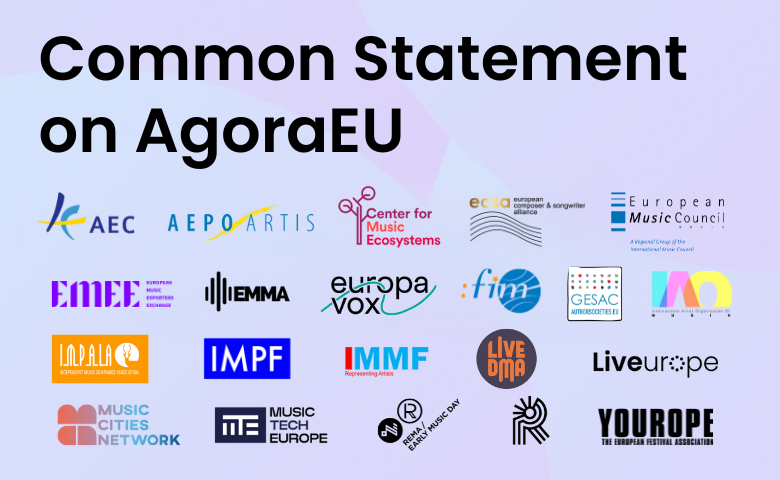
List of signatories
- AEC – Association of European Conservatoires
- AEPO-ARTIS – Association of European Performers’ Organisations
- Center for Music Ecosystems
- ECSA – European Composer and Songwriter Alliance
- EMC – European Music Council
- EMEE – European Music Exporters Exchange
- EMMA – European Music Managers Alliance
- Europavox
- FIM – International Federation of Musicians
- GESAC – European Grouping of Societies of Authors and Composers
- IAO – International Artist Organisation of Music
- IMPALA – Independent Music Companies Association
- IMPF – Independent Music Publishers Forum
- IMMF/MMF EU – International Music Managers Forum
- Live DMA
- Liveurope
- MCN – Music Cities Network
- MTE – Music Tech Europe
- REMA – European Network for Early Music
- Reset!
- YOUROPE