During the General Assembly at the AEC Congress in November in Salzburg, a discussion was initiated regarding AEC’s approach and the transparency of its decision-making in relation to the ongoing crisis in Israel and Palestine. As a result, it was decided to convene an AEC Members’ Dialogue Session, which took place online on 13 January.
AEC is a respected international organisation with decades of experience in Higher Music Education. However, it is not often that AEC has had to address the dilemmas that arise when members suddenly find themselves on opposite sides of major geopolitical conflicts.
The purpose of the session was to create a safe space for members to express their concerns and viewpoints, and for AEC, as a membership organisation, to listen carefully in order to gain a deeper understanding of how it can navigate the political and value-based dilemmas that emerge within the membership as a result of developments in society.
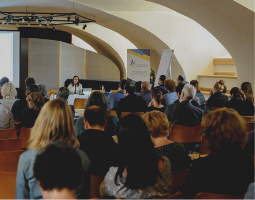
Nearly 70 participants, including several members of the AEC Council, engaged in an open and respectful dialogue, moderated by Niels Righolt from the Danish Centre for Arts & Interculture and former Vice-President of Culture Action Europe.
The discussions can be summarised around several overarching themes. First and foremost, some criticism was voiced regarding what was perceived as a lack of transparency and consistency in AEC’s decisions, particularly in relation to the treatment of members in conflict-affected countries. We had a fruitful exchange on the similarities and indeed differences between some situations, and how such nuances might affect decisions.
There was a call for guidelines or a clear set of values that could serve as a reference framework to support future decision-making, for example concerning the suspension of membership or exemption from membership fees. It was also suggested to establish an AEC working group on human rights and/or to involve formal expertise in the field of human rights.
Several contributions emphasised that human rights should not be considered negotiable, and that, even in highly complex situations, there remains a responsibility to act. Others highlighted the importance of recognising that these issues are sensitive and multifaceted, and that any response from AEC should be aligned with its role as a diverse membership organisation. Some participants suggested that symbolic actions could be one option among several ways to engage, while others encouraged AEC to proceed carefully and consider the impact of any public stance on the diversity of perspectives within the network.
Finally, many contributions encouraged AEC to invite Palestinian institutions into the community, thereby opening space for an important voice that, until now, has not been part of the conversation. Already today, some member institutions collaborate with Palestinian institutions and musicians, suggesting that AEC could build on existing connections. We are very grateful for their willingness to make those connections for us.
The AEC Council will meet on 10 and 11 March, where all ideas will be thoroughly considered.
The AEC Council and Office thank all participants for their thoughtful contributions and their constructive engagement with a complex topic.