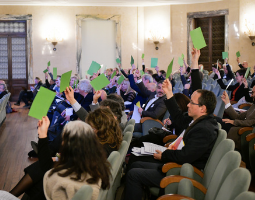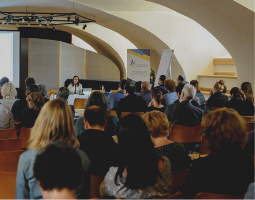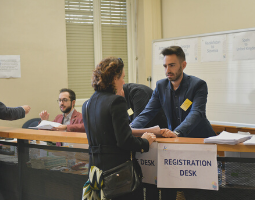
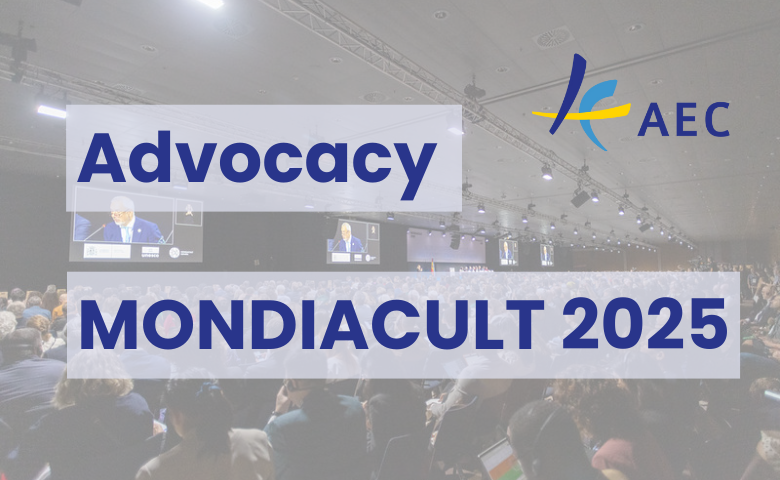
Between 29 September and 1 October 2025, the AEC proudly represented the higher music education sector at the World Conference on Cultural Policies, hosted by UNESCO in Barcelona. The event brought together ministers of culture and education, representatives from the cultural and creative industries, and international organisations to shape the global cultural agenda around key themes such as cultural rights, digital transformation, culture in education, climate and heritage, the cultural economy, and culture in times of crisis. Two special focus areas: artificial intelligence and culture, and culture for peace, framed some of the most forward-looking discussions of the conference.
For AEC, this forum provided a timely opportunity to engage with broader cultural policy debates: the role of culture as a public good; the intersections between music education, cultural rights and the creative economy; and the emerging expectations of culture’s place in sustainable development and education systems.
Key outcome: Barcelona Declaration / Outcome Document
At the close of the conference, a comprehensive outcome document was adopted, and the key messages can be summarised as follows:
- Culture must be recognised not as a marginal add-on but as a fundamental pillar of sustainable development, human rights and social inclusion.
- The right to participate in cultural life (and thus the right to culture) is reaffirmed as a human right and must underpin cultural policy and education policy going forward.
- Culture and the arts must be integrated into other policy domains: education, digital/AI, climate action, heritage protection and crisis response.
- Robust data, monitoring and evidence frameworks are required to capture the contribution of culture and the creative sectors (for example, the newly launched global report) and to inform policy and investment.
- The creative, cultural and education sectors must embrace the digital transformation and artificial intelligence responsibly, ensuring creators’ rights and cultural diversity are protected.
- Culture has a key role in peacebuilding, dialogue and resilience, particularly in a context of growing geopolitical, climate and social crises.
For AEC and its membership, the implications are clear: HMEIs are not solely training artistic professionals but are part of the cultural ecosystem which contributes to social cohesion, lifelong learning, creative economies and cultural rights. The Barcelona outcome provides a strong policy anchor for elevating the role of the conservatoire in local, national and international contexts.
Other important documents presented at MONDIACULT
Two major publications were launched at the conference, which are of particular relevance for AEC and our sector:
- UNESCO Global Report on Cultural Policies – Culture: The Missing SDG
This inaugural global report on cultural policies draws on data from over 1,200 national and local reports and 200 case-studies submitted between 2019 and 2024. It demonstrates key trends: 93 % of countries now reference culture in their SDG policies (even if often without clear targets or indicators) and the cultural and creative industries account for 3.39 % of global GDP (though with dramatic disparities across income-groups).
The report argues for culture to be recognised as a stand-alone goal in the post-2030 UN development framework.
Link to full report: UNESCO Global Report on Cultural Policies – Culture: The Missing SDG - Implementation Guidance for the UNESCO Framework for Culture and Arts Education
This guidance document was launched at MONDIACULT (1 October 2025) and builds on the earlier Framework adopted in 2024. It provides practical orientations for embedding culture and the arts across formal, non-formal and informal education, throughout life.
It emphasises inclusive access, lifelong learning, partnerships between culture and education sectors, digital and AI challenges, and the value of co-creation and community engagement.
Link to the guidance: Implementation Guidance for the UNESCO Framework for Culture and Arts Education
What this means for AEC and its members
- The international recognition that culture matters, mobility matters, and creative education matters strengthens the foundations of AEC’s ongoing advocacy. We will continue to build on this momentum to amplify our collective voice for the higher music education sector in Europe and beyond.
- Across our membership, HMEIs are not only training professional musicians but also engaging in community projects, interdisciplinary collaboration, and lifelong learning initiatives. The new Implementation Guidance for the UNESCO Framework for Culture and Arts Education provides a useful policy lens and shared vocabulary for recognising and strengthening this work.
- AEC is committed to deepening its work on data and evidence. The Global Report on Cultural Policies highlights the need for robust cultural data to inform national and international policy. AEC will over the coming years establish a framework to gather and share data demonstrating the social, cultural, and economic contributions of higher music education to Europe’s wider cultural ecosystem.
- The link between culture, digital/AI and education is explicitly highlighted in the Barcelona outcome. Many institutions are pioneering projects in digital performance, AI-driven composition, and cross-sectoral innovation. The MONDIACULT 2025 outcomes confirm the importance of this work and encourage further exploration of responsible and creative uses of digital and AI technologies in music education and cultural production.
- Outreach, social engagement, and cooperation with local communities are integral to many conservatoires’ missions. AEC will continue to support members in developing these practices and aligning them with international frameworks that value lifelong, inclusive, and socially relevant arts education.
AEC’s presence at MONDIACULT 2025 underlines our commitment to ensuring that HME is connected to the broader cultural and policy ecosystem. We look forward to continuing this engagement – using the links provided to deepen our work, to share good practice among members, and to align our initiatives with the new global frameworks for culture, education and development.