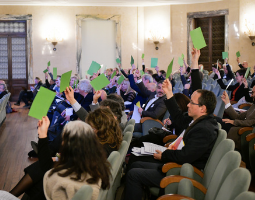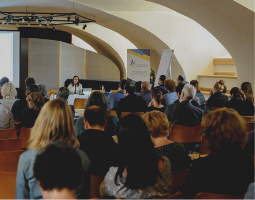
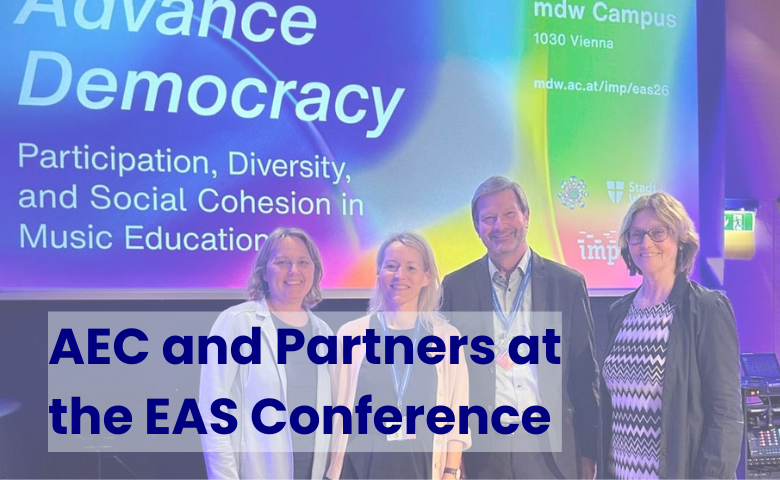
At the conference AEC participated actively as co-chair with colleagues from the permanent working group Steering Committee for the Harmonisation of European Music Education (SCHEME) in the session Advocacy in Action: How Schools and Organisations Can Shape the Next EU Budget.
The session explored how EU priorities for culture and education are decided – and how schools, organisations, and practitioners can influence them? The question is extremely pressing right now, because the multi-year financial budget of EU funding programs is currently being negotiated (see the advocacy update above) – with major implications for cultural policy and the role of music education in the countries.
Following this session SCHEME has decided to take part in the current advocacy activities taking benefit of its large network of membership organisations and national coordinators across Europe. The plan is to reach out to the EU member state governments before the summer addressing topics such as music teacher shortage and access to music education for all.
Several projects in the music education field to which AEC is connected as project partner or associated partner presented a rich variety of project outcomes.
dialoguing@rts
dialoguing@rts (d@rts) aiming to “Advance Cultural Literacy for Social Inclusion through Dialogical Arts Education” explores how performing arts education can foster inclusion and contribute to social cohesion by enhancing cultural literacy. The project spans Norway, Finland, Germany, Italy, Serbia, Uganda, and Aotearoa New Zealand, engaging participants of all ages and roles, especially in schools and community arts.
It combines a large-scale, participatory and critically reflective research framework with in-depth ethnographic studies and community-based artistic practices.
Across these strands, the project:
- develops and tests culturally sensitive research approaches that account for diverse perspectives and aim to decolonise methodologies,
- investigates how inclusion is enabled and constrained within educational and institutional settings,
- and implements participatory artistic initiatives that engage communities, support dialogue, and promote both individual and collective learning.
Overall, it highlights the potential – and the structural challenges – of using dialogical and arts-based approaches to strengthen social cohesion, inclusion, and democratic participation.
TEAM
Within the Erasmus+ project TEAM, a dedicated initiative on student mobility is addressing a persistent challenge in music teacher education: despite its well-known academic, professional, and intercultural benefits, mobility participation remains low due to structural and curricular barriers.
To tackle this, the project brought together 13 higher education institutions across Europe to investigate current practices and develop practical, research-based solutions. Using a combination of document analysis, interviews, and iterative design work, the initiative identified key obstacles such as weak institutional alignment, limited student support, unequal access to funding, and difficulties integrating music-specific studies into exchange programmes.
In response, the project has developed a set of design principles to improve mobility in music teacher education. These focus on strengthening collaboration between institutions, embedding mobility more effectively into curricula, enhancing student support and preparation, and fostering meaningful cultural engagement. The design principles will be disseminated by AEC as soon as they are officially published.
Keynote
A very strong feature of the conference was Prof. Dr. Yvonne Wasserloos’ keynote “Destroy Democracy” – Undermining Society through Mainstream Music and AI-Generated Hate.
Yvonne Wasserloos, who has been a university professor of musicology at the Mozarteum University Salzburg since 2022, has earned an outstanding reputation in the international research community through her extensive expertise in the history of music from the 18th to the 21st century, as well as through her in-depth analyses of political and societal contexts. In autumn 2023, she founded the research focus “Music and Power” (AMUM) at the Mozarteum University.
In her keynote at the conference, Yvonne Wasserloos demonstrated how far-right movements in Europe use highly sophisticated methods to exploit music – including works by well-known artists – for disinformation purposes. A particular focus of the keynote was her recent research on the use of AI, with examples clearly showing how AI makes it increasingly difficult for audiences to decode and identify the underlying intentions behind the many posts distributed via social media.
The key question that remained after the keynote was how we can protect ourselves – and especially children and other vulnerable groups – from this type of propaganda, and what measures can be taken to counter these developments, including strengthening teacher education.
Thanks to the European Association for Music in Schools (EAS) for a very well-organised, important, and inspiring conference.