AEC joins European dialogue on music and arts education in Prague
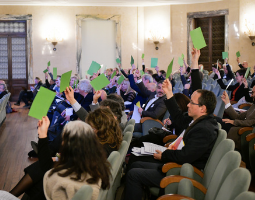
AEC was pleased to participate in the 51st General Assembly, Forum and Conference of the European Music School Union, which took place in Prague from 4 to 7 June 2026 at the invitation of AZUŠ ČR.
The event brought together around 70 EMU members, Board members, European partner organisations and invited speakers to discuss advocacy, democracy, participation and the future of music and arts education in Europe. For AEC, the conference offered an important opportunity to strengthen dialogue with partner networks and to underline the essential connection between early music education, general education, music and arts schools, Higher Music Education (HME) and professional musical life.
AEC sees access to quality music education from an early age as a fundamental precondition for a thriving music life in Europe. It is also an important basis for the development of young talents who may later continue their artistic pathway as students in HME institutions. Ensuring broad, inclusive and high-quality access to music and arts education is therefore not only a question of cultural participation, but also a strategic priority for the whole music education ecosystem.
A key moment of the conference was the presentation of the Steering Committee for the Harmonisation of European Music Education (SCHEME), the ongoing cooperation between AEC, EAS and EMU. Together, the three networks connect the full field of institutionalised music education in Europe: from children in music and art schools and pupils in general education to students in HME.
AEC Executive Director Finn Schumacker and EMU President Michaela Hahn presented first insights into the upcoming joint SCHEME campaign, which aims to strengthen the political recognition of music and arts education at European level and contribute to policy discussions on future EU funding.
AEC will continue to work closely with EMU and EAS, with a particular focus in the coming months on the MFF negotiations, our calls for adequate funding, and policy recommendations aimed at improving access to music education for all and strengthening the music teaching profession across Europe.
Building new bridges between music education and the music industry
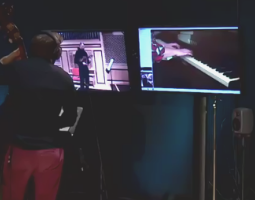
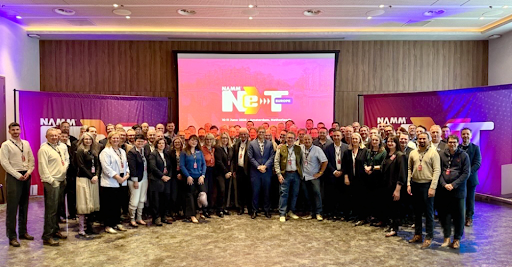
AEC contributed to NAMM NeXT Europe 2026, which took place in Amsterdam on 10–11 June. Organised by NAMM, the summit gathered senior leaders from the European music products sector, including representatives from musical instrument manufacturing, pro audio, live events, retail, distribution and education.
The invitation to join the programme alongside the European Music School Union (EMU) and the European Association for Music in Schools (EAS) opened a valuable space for dialogue with parts of the music industry that are not always closely connected to higher music education. At the same time, the conversations showed a clear common interest across the sector: strengthening active participation in music making and supporting more people in learning, creating and performing music.
AEC Executive Director Finn Schumacker joined Romain Asselborn from EMU and Benno Spieker from EAS in a session on Strengthening Advocacy Through Education-Industry Collaboration. The session presented perspectives from across the European music education landscape, from music in schools to Higher Music Education.
Throughout the summit, participants explored current developments affecting the music products industry, including economic and trade trends, artificial intelligence, changing consumer behaviour, retail, manufacturing, live events and music education advocacy. A recurring theme was the need to encourage more people to become active music makers.
From AEC’s perspective, this dialogue is highly relevant and NAMM NeXT Europe highlighted the potential for stronger cooperation between education networks and the music industry. AEC looks forward to continuing the conversation with NAMM, EMU, EAS and other partners, and to exploring how education and industry can work together to expand access to music making across Europe.
© NAMM
EMC – EFM
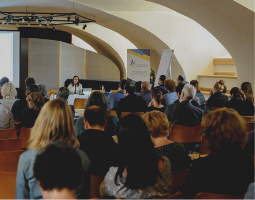
The 14th European Forum on Music (EFM), organised by the European Music Council in Timișoara, offered a great opportunity to explore an increasingly vital theme: Music, Health, and Wellbeing. By bringing together researchers, musicians, and healthcare professionals, the Forum highlighted the powerful ways music enhances physical, psychological and social wellbeing.
The conversations made one thing clear: as research and debate continue to validate the benefits of music, the focus is shifting toward action. The big questions now are how to effectively engage policymakers and how to deepen collaboration with the healthcare sector.
Here are a few key takeaways from the discussions:
Supporting the creators: While music is a powerful healing instrument, discussions strongly emphasized that it is a two-way street. Focus was placed on the health and wellbeing of musicians themselves, reflecting on the necessity of creating safer environments supporting musicians themselves.
Community is key: Several cases illustrated how music builds social connection and resilience—whether by helping individuals navigate loneliness, and trauma.
Systemic change: Attendees emphasized the need for structural policies and cross-sector partnerships to ensure these health and wellbeing benefits are accessible to the wider public.
We look forward to getting involved in these future discussions and stand ready to engage our own community in the journey ahead.
Connecting Practice to Policy: Creative Europe Culture project coordinators gather in Brussels
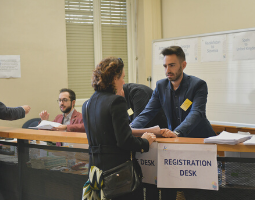
On 12 June, more than 70 representatives from European cultural networks, platforms for emerging artists, orchestras and sectoral initiatives gathered in Brussels for a dedicated meeting with the Culture Unit of the European Education and Culture Executive Agency (EACEA) and the European Commission’s Directorate-General for Education, Youth, Sport and Culture (DG EAC).
The meeting brought together beneficiaries and partners from across the Creative Europe Culture ecosystem, including initiatives such as Music Moves Europe, Perform Europe, the European Heritage Label and the European Heritage Hub. For AEC, the meeting offered an important opportunity to exchange with partner networks, compare experiences across sectors and contribute concrete suggestions for how future EU support programmes for culture and education can better respond to the needs of practitioners.
The discussions focused on two main questions: whether the current design of Creative Europe still meets the needs of the cultural sectors, and how future programmes can better address artists’ working conditions, artistic freedom, culture and health, and access to finance for the cultural and creative sectors.
A clear message emerged from the discussions: the quality of EU support matters as much as the overall level of funding. Participants called for more flexible and process-oriented funding mechanisms, allowing projects to adapt to changing circumstances, as well as simpler administrative procedures and support instruments that reflect the realities of cultural organisations of different sizes and capacities.
The development of the Higher Music Education sector in Europe has, for many years, benefited immensely from the support made possible through Creative Europe and other support programmes, including through projects such as SMS and ARTEMIS. AEC is deeply grateful for this support, which has enabled transnational collaboration, shared learning and strategic development across our community. AEC will continue to make full use of these opportunities to strengthen cooperation and contribute to a resilient, innovative and inclusive future for Higher Music Education in Europe.