Over the past year, AEC has been working with its members on an important question: how should the association respond when political conflict, war or humanitarian crises affect our members and our wider community?
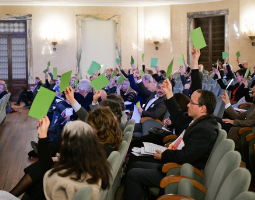
Following discussions at the AEC Congress in Salzburg in November 2025, AEC opened a dedicated conversation with its members on how the association should respond to situations of conflict.
Listening to members
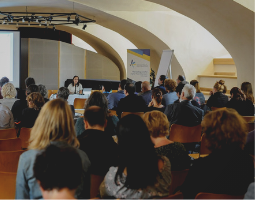
The first members’ online dialogue took place on 13 January 2026, with around 70 participants, moderated by Niels Righolt of the Danish Centre for Arts & Interculture. It was designed as a safe space where members could share their concerns and AEC could listen. Many called for clearer guidelines and shared values to guide future decisions; some stressed AEC’s responsibility to act, while others asked for care, so that any stance respects the diversity of views across the network.
A mandate from the Council
At its March 2026 meeting, the AEC Council:
- decided to invite the Edward Said National Conservatory of Music in Palestine to become a member of AEC;
- explored how AEC might support Palestinian artists and students through existing mobility and cooperation opportunities;
- concluded that AEC would benefit from an agreed basis for responding when member institutions are affected by war, conflict or other exceptional geopolitical circumstances, and asked the AEC Office to prepare a framework for ethical decision-making.
The framework is not meant to produce an automatic answer to every difficult situation. Conflicts differ, institutions differ, and circumstances change. Instead, it should give AEC a clearer way to address four questions: When does an issue fall within AEC’s remit? Which values and considerations should guide us? Who should be involved in the decision? And how should that decision be communicated?
An emerging direction
In September, the Council held an extended discussion based on a question bank prepared by the AEC Office. It did not produce final answers, but it confirmed an emerging direction. There was broad support for AEC staying focused on its areas of competence (music, culture, higher education, research, and artistic and academic freedom) rather than becoming a general political organisation. There was also support for a flexible framework that helps AEC decide whether to take up an issue and, where it does, to consider each case carefully on its own merits.
The International Relations Coordinators also explored the topic at their annual meeting in September, sharing real cases and a common vocabulary for the different ways an organisation can respond. Their message: offer concrete examples, work with partner networks, and take the time needed to get this right.
A second members’ online dialogue took place on 23 October, with contributions from three colleagues whose institutions experience conflict in very different ways: Sima Khoury Odeh (Edward Said National Conservatory of Music), Dr Judita Žukienė (Lithuanian Academy of Music and Theatre) and Prof. Bernard Lanskey (Queensland Conservatorium Griffith University). The views shared will be considered alongside the January dialogue and the Council’s discussions.
At the Congress, 4–7 November 2026
The discussion group Transnational Academic Networks in Times of Political Turmoil will open the conversation to the whole membership: heads of institutions, teachers, staff and students. In a safe and respectful setting, participants will explore where institutional responsibility ends and political positioning begins, how to balance neutrality and engagement, and how a network can make room for different voices while staying united.
What comes next
A final online dialogue session for members is planned for February 2027. The AEC Office will then prepare a draft framework for the Council’s March meeting, with the aim of presenting it to the General Assembly in 2027.
This is deliberately a careful process. With more than 300 member institutions, AEC brings together many different views, so any framework must be practical, principled and grounded in AEC’s core purpose. It will not make difficult decisions disappear or remove the need for judgement, but it should help us test each case against shared principles, explain our reasoning clearly and take responsibility for decisions made in the name of the association.
Thank you to everyone who has shared their experience so far.