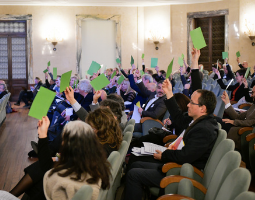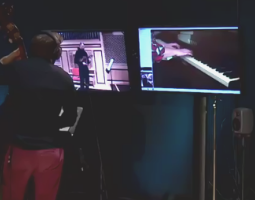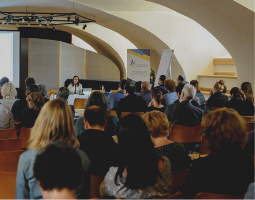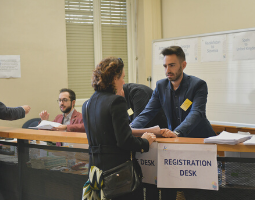
Between January and March 2026, with the support of the IartNET project, AEC produced a series of five webinars, which reflected the diversity of contemporary artistic research practices, combining theoretical reflection with practical examples and institutional perspectives. Across the five sessions, speakers explored themes including interdisciplinarity, doctoral education, quality assurance, evaluation, and international networking. The project is led by Accademia delle Belle Arti di Brera, and the activities organised by the AEC are coordinated by Conservatorio Luca Marenzio di Brescia.
The series opened on 13 January with Teaching Artistic Research in Cross- and Transdisciplinary Settings, led by Gilvano Dalagna — invited Assistant Professor at the University of Aveiro, invited lecturer at the Universidad Alfonso X El Sabio, and integrated researcher at the Institute of Ethnomusicology – Centre of Studies in Music and Dance (INET-md) — together with Jorge Salgado Correia from the University of Aveiro and INET-md. The session examined how artistic research operates when disciplinary boundaries are crossed or challenged, discussing methodological approaches, knowledge creation, and the balance between artistic and academic values. Questions surrounding collaboration and assessment in interdisciplinary environments generated particularly rich discussion among participants.
The second webinar, Evaluation and Assessment of Artistic Research (12 February), focused on quality assurance and evaluation practices in higher music education. The work and activities of the agencies MusiQuE and EQ-Arts were presented and reflections on institutional evaluation processes in the arts sector were shared by their representatives. Anna Scott, Assistant Professor at Leiden University’s Academy of Creative and Performing Arts (ACPA), addressed the evaluation and assessment of artistic research at doctoral level, discussing criteria for supervision as well as the institutional support structures and soft skills needed for effective doctoral guidance.
The webinar Governance of Doctoral Programs in the Arts (20 March) turned the spotlight to doctoral education and sustainability. The session featured Helena Marinho, Associate Professor at the Department of Communication and Art of the University of Aveiro, coordinator of the University of Aveiro branch of INET-md, and member of the scientific committee of the PhD in Music programme, together with Benjamin Helmer, composer, lecturer in music theory and aural training, and research assistant at the Hamburg University of Music and Drama. Helmer coordinates the ARTILACS graduate programme and works at the Ligeti Center’s Artistic Research Lab, supporting doctoral project funding in artistic research. The webinar addressed supervision practices, financing and sustainability of PhD programmes, career opportunities after doctoral studies, and the integration of artistic research perspectives into bachelor’s and master’s curricula.
The topic of Interdisciplinarity between Arts, Science and Technology was then explored (21 March) by composer and researcher Emily Doolittle, whose work focuses on zoomusicology and the music-like aspects of animal songs, and musician and researcher Alex South, whose work explores animal musicking, bioacoustics, and human-animal relations mediated through sound – both from the Royal Conservatoire of Scotland. Through the presentation Cetacean citations: an interdisciplinary artistic research PhD on humpback whale song, the speakers offered participants a compelling example of interdisciplinary artistic research in practice. The session reflected on both the opportunities and challenges of working across artistic and scientific domains, including questions of supervision, institutional structures, and assessment.
The series concluded with Local Networks as Drivers in the Development of Artistic Research (31 March), presented by Kevin Voets, Head of Research at the Royal Conservatoire Antwerp. Kevin reflected on the development of artistic research culture in Flanders and the transformation of conservatoires into Schools of Arts. His presentation explored the interconnected research networks supporting artistic research in Antwerp, including the Antwerp Research Institute for the Arts (ARIA), the doctoral network docARTES, and the transnational platform FORUM+. The session illustrated how local, national, and international collaborations contribute to strengthening artistic research ecosystems across Europe.
Taken together, the five webinars demonstrated both the vitality and the growing complexity of artistic research in higher music education. They also reinforced the importance of dialogue across institutions, disciplines, and national contexts. By bringing together diverse voices and experiences, the IartNET webinar series created a valuable space for reflection, exchange, and future collaboration within the international artistic research community.
Recordings of all webinars are available on the AEC YouTube channel.
More on the IArtNET project:
Coordinated by Academia delle Belle Arti di Brera, Milano, the IartNET project aims to strengthen the internationalization of Italian Higher Arts and Music Education (AFAM) institutions by fostering transnational cooperation grounded in connectivity, experimentation, innovation, and diversity. IartNET operates through collaborative networks to generate shared benefits across the AFAM sector.