Along with the Green Travel Incentive, the AEC initiated several initiatives to raise awareness of the climate emergency and highlight how individual choices, including travel, can make a difference.
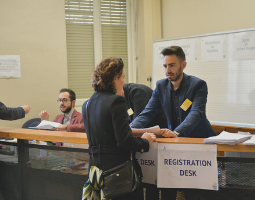
One such initiative was the pilot Green Travel Desk, located at the registration desk during the IRCs. It offered participants the opportunity to calculate the emissions associated with their journey and understand their environmental impact through tangible, real-life comparisons, such as:
- Travelling by train: : A journey from Berlin to Trento by train generates approximately 32.4 kg of CO₂. To put this into perspective, this is equivalent to the emissions associated with producing 324 plastic bottles or 5 t-shirts, boiling water for 926 cups of coffee, or 1,620,000 QR code scans. It would take approximately 1.5 trees a year to absorb this amount of CO₂.
- Travelling by plane: Flying from Berlin to Venice, one of the closest airports to Trento, generates approximately 324.7 kg of CO₂. This is equivalent to the emissions associated with producing 3,249 plastic bottles, 46 t-shirts, 9,257 cups of coffee and scanning a QR code 16,200,000 times. It would take approximately 15 trees a year to absorb this amount of CO₂.
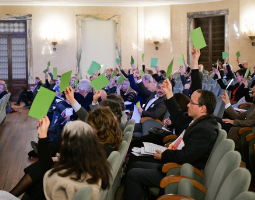
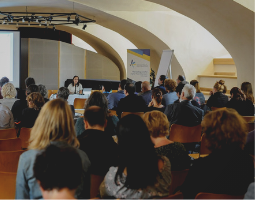
Moreover, the participants of the Annual Meeting for International Relations Coordinators took part in a discussion group on green travel, titled “. Travel Differently: Exploring Green Mobility in Higher Music Education ”
This session explored the challenges of low-carbon travel, shared the best examples already implemented by individual institutions, and examined how the AEC and in particular its newly established Network of Green Officers could contribute to promoting environmentally friendly travel practices across the sector.
A central thread running through the discussion was the question of what hinders greener travel, whether structural, financial, cultural or logistical, and what role students play in pushing for change or shaping institutional priorities. Participants drew on concrete experiences from their own contexts, including cases where green travel policies exist on paper but struggle to take hold in practice. Useful and practical tools and resources on green travel were also shared for participants to bring back to their institutions and use in their daily work.
Find the presentation from the session here.