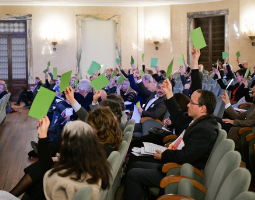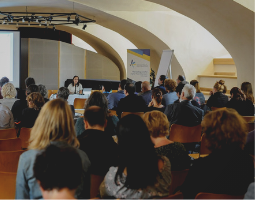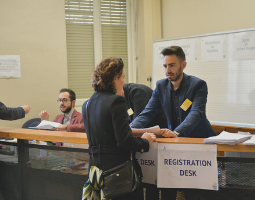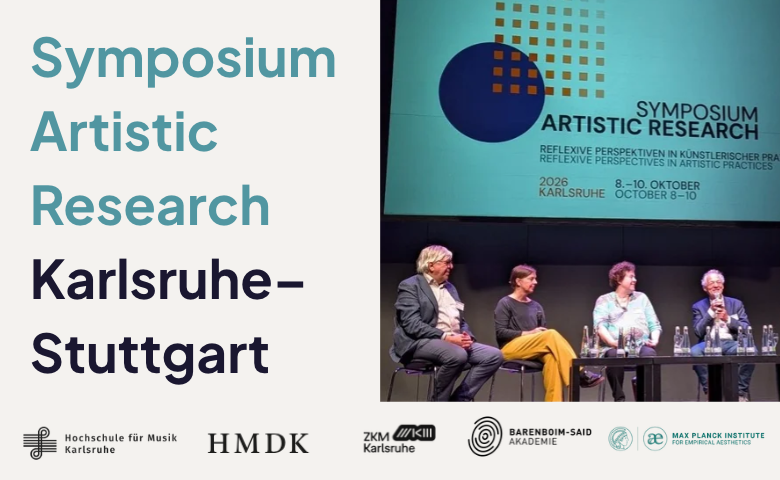
From the 8th to the 10th of October 2026, the Hochschule für Musik Karlsruhe and the Hochschule für Musik und Darstellende Kunst Stuttgart convened the symposium Artistic Research: Reflexive Perspectives in Artistic Practices, in collaboration with the Max Planck Institute for Empirical Aesthetics (Frankfurt am Main) and the Barenboim-Said Akademie (Berlin). The symposium was curated by Arabella Pare (Karlsruhe) and Matthias Hermann (Stuttgart). The collaboration welcomed artist-researchers, musicians, academics and institutional representatives from across Europe to mark the launch of a new PhD programme in artistic research in music. German Music Higher Education Institutions (HEI) are now more broadly in a position to offer doctorates in artistic research, a field for which the AEC’s EPARM conferences have provided an international platform for exchange and discussion since 2011.
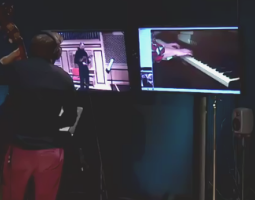
The symposium approached the question of artistic identity and reflexive practices in the context of research, in which a practitioner’s way of performing, hearing, shaping, or creating becomes an object and a method of enquiry. Eighteen projects were presented in six parallel sessions, many of them as lecture-performances, ranging from contemporary recorder music from Japan and the whistling voice to climate lamentation and the inheritance of historical performance practices. Alongside the presentation of hands-on examples of good practice, some fundamental issues relating to methods, thematic areas and the raison d’être of artistic research were raised for debate and discussed with lively engagement. Two evening concerts, including works for acoustic instruments, voice and live electronics, as well as repertoire from the 18th to the 20th century on historical keyboards, extended the spectrum of research presentations.
Two sessions of Best Practice International were devoted to presentations by representatives from institutions which continue to be significant in shaping perspectives and practices of artistic research. Peter Dejans, founding director of Orpheus Instituut in Ghent, drew on three decades of experience to examine how the impetus towards proposing research that can be ‘described in advance’ impacts the future of individual projects and the discipline as a whole, pointing towards the opportunities present at the beginning of a new programme to take a different path. Kristel Pappel looked back at twenty-six years of artistic research doctorates at the Estonian Academy of Music and Theatre, demonstrating the intersection of artistic practice and academic positionality and the evolution of the programme, while granting insights into the day-to-day life of the doctoral researchers. Stephen Broad described the research culture at the Royal Conservatoire of Scotland with an analogy to the task of cultivating a diverse garden, in which respect for difference between disciplines and support for the breadth of research perspectives is not an aspiration but a condition of working together.
Further perspectives came from institutions reflecting on processes of transformation in artistic research. Rosemarie Brucher, vice-rector for research, outlined the ethos behind the artistic-scholarly doctorate at the MUK in Vienna, its recent accreditation (2024), and the social and ethical responsibilities of researchers enrolled in the programme. Bruno Pereira spoke on the epistemology of experimentation in the context of the transformation of ESMAE in Porto as it moves into a university structure and establishes a new PhD in Music. Common to these sessions was the question of how an institution can facilitate doctoral research while looking towards the future of the discipline.
Barbara Lüneburg and Stefan Gies shifted the perspective to the researcher’s own position, examining how artistic identity is constituted, positioned, and reconfigured once one’s practice becomes the medium of research. Giving insights into the process of crossing thresholds, for example between methodological accountability and artistic autonomy, Barbara spoke on the artist-researcher’s sense of agency, responsibility and professional identity. Stefan examined the intersection of artistic identity and epistemic interest with discourse on reflection and innovation through specific case studies. Anne-May Krüger complemented these perspectives with the Master of Arts at the Basel Academy of Music, which since 2023 has attracted musicians for whom research is central to their artistic profile.
The closing panel brought together Margit Szöllösi-Janze, James Helgeson, Stefan Gies, Barbara Lüneburg, Arabella Pare, and Matthias Hermann. Five years after the German Science and Humanities Council (Wissenschaftsrat) presented its recommendations on the postgraduate qualification phase at Arts HEIs, in which it characterised artistic research scenarios as ‘hybrid’, the panel discussed the publication’s wide-ranging effects on the research landscape. Centred on an expansive concept of knowledge through and for artistic practice, the panel reflected on the nature of knowledge and transfer in artistic research. The criteria of the Frascati Manual, that research should be novel, creative, uncertain, systematic, and transferable and/or reproducible, were of overarching significance for the panel. Transferability emerged as the more fitting criterion in artistic research: the capacity of knowledge to become intelligible and productive for others across the distance that separates their positions, allowing the singularities of artistic practice to contribute to broader knowledge.