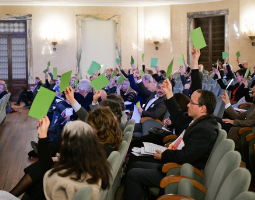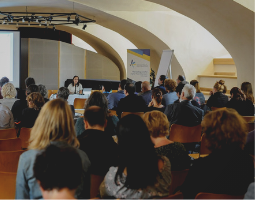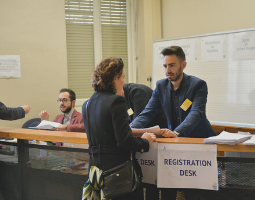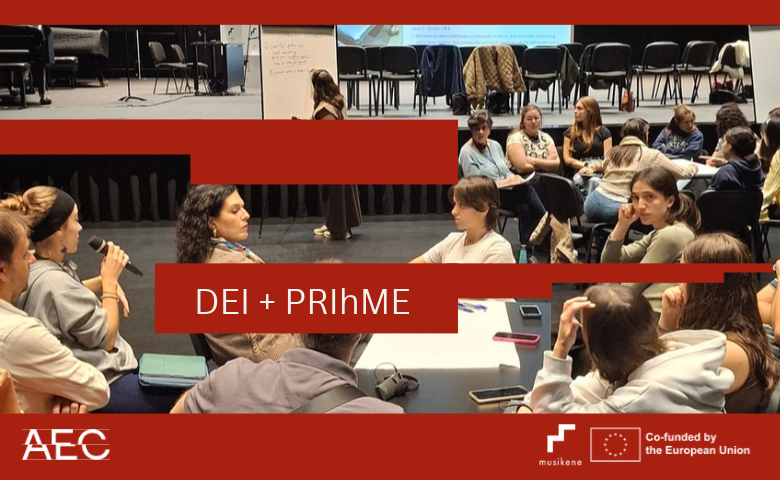
On 8 and 9 October, the AEC ran two workshops on Diversity, Equity and Inclusion (DEI) and on power relations at Musikene – Centro Superior de Música del País Vasco. Around 30 staff and students took part over the two days. The workshops continue the institutional visits by the AEC DEI Panel of Experts, following the first workshop of the year at HKU Conservatorium Utrecht in May.
DEI Workshop – 8 October
On 8 October, the AEC DEI Panel of Experts ran a four-hour workshop called Diversity, Equity and Inclusion in Higher Music Education: An Invitation for Action. It was facilitated by Panel members Monica Vejgaard, Martha Lomeli-Rodriguez and Enric Aragonès Jové, together with Alessandra Callegari from the AEC Office.
The workshop is not a lecture or a training course. It is meant to be a space for open dialogue and exchange, where staff and students can reflect together on what diversity, equity and inclusion mean in their own institution and in their artistic practice. Bringing different roles into the same room is central to the approach. Students and staff each bring their own experiences, questions and expectations, and the conversation is shaped by the people who take part.
Through a World Café format, participants talked about who is represented in higher music education and who is missing, how power is distributed, and what success looks like in a conservatoire and who it is open to. The discussions moved from naming challenges, to imagining what could be different, to identifying concrete steps forward. Throughout, the conversations stayed close to the artistic core of higher music education: what music is taught and valued, who makes those decisions, and how inclusion can be reflected in teaching and learning.
One message came through clearly: participants want to move from talking about DEI to putting it into practice. The facilitators linked the issues raised to resources from AEC projects, including ARTEMIS, SMS, PRIhME and IncluMusic. Before leaving, each participant committed to one action they could start now, in their everyday life and in their institution.
PRIhME Workshop on Power Relations – 9 October
On 9 October, a four-hour PRIhME workshop on power relations was delivered to staff and students of Musikene as an add-on to the DEI workshop. It was facilitated by the PRIhME workshop facilitator, David-Emil Wickström.
The workshop drew on the findings of the AEC PRIhME project, Power Relations in Higher Music Education (2020–2023 Erasmus+ Strategic Partnership), in which Musikene was a project partner.
The workshop looked at how power relations are defined and expressed in higher music education institutions (HMEIs), with particular attention to their distinctive teaching context. Excellence, high musical standards and close teacher–student relationships are hallmarks of higher music education, and the workshop discussed both the clear advantages they bring and the specific challenges they create. It drew on the outcomes and materials of the PRIhME project, in particular its recommendations, which give HMEIs a framework for addressing power relations and creating a safe space within the institution.
The workshop combined interactive, reflective and game-based exercises with group discussion of case studies. Participants gained a deeper understanding of power relations and how they are expressed in HMEIs, the role of students, and reporting procedures. They also discussed what excellence and success mean from the perspectives of students, teachers and administrative staff.
The PRIhME workshops are offered to the AEC membership. They aim to strengthen cooperation and networking between institutions on power relations, to promote healthier and more sustainable careers for both staff and students in higher music education. More broadly, the workshops raise awareness of power imbalances in higher music education and encourage institutions to reflect on these issues, by providing information, tools and policy recommendations.
Two days, one conversation
Musikene asked the facilitators to connect DEI with the theme of power and with how change can be put into practice in institutions, so the two days built on each other. The first day opened a broad conversation about representation, belonging and barriers. The second went deeper into the power dynamics that shape everyday life in a conservatoire. The AEC warmly thanks Musikene, for its hospitality, its commitment and its support in organising the workshops.
The AEC DEI Panel of Experts is available to bring these workshops to other member institutions. To find out more, contact Alessandra Callegari at alessandracallegari@aec-music.eu