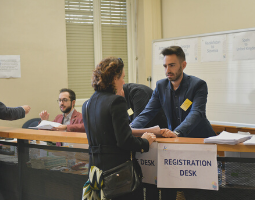

Registration Opens (with welcome coffee)
Workshop: Navigating the Digitisation of Erasmus+ Procedures
Workshop: Navigating the Digitisation of Erasmus+ Procedures
This workshop will provide a comprehensive update on the current state and future directions of digitisation in higher music education, with a focus on Erasmus Without Paper (EWP) and on the AEC EASY MO System. The opening plenary will set the scene with an overview of the present situation of the sector: progress in building the EWP infrastructure, insights from the recent AEC Digitisation Survey, and an outline of financial and organisational developments of EASY MO. Participants will also hear about the technical challenges encountered in 2025 and the lessons learned through extensive testing and implementation.
Looking ahead, the plenary will highlight the benefits of moving forward collectively as a consortium, the importance of AEC’s advocacy role, and concrete next steps, including the rollout of the portal and ticketing system by December 2025, and the commitment process for institutions joining the consortium in 2026 under the new conditions that will be announce in the session.
In parallel sessions, participants will engage in tailored discussions: newcomers will be introduced to the AEC EASY MO system, advanced users will explore the DLA Pipeline, new functions and address technical issues, and a dedicated group will focus on the EWP Dashboard and related issues.
The closing plenary will open the floor to reflections from the AEC EASY MO Task Force and participants, inviting a collective conversation on the future of digitisation for higher music education institutions. Together, we will reflect on how to best position the sector to meet the challenges and opportunities of the coming years.
Workshop Structure:
14:00 – 15:30: Plenary Session on EWP and EASY MO in Solti Hall first floor
15:30 – 16:00: Coffee Break
16:00 – 17:00 Discussion Groups
– Group 1 Solti Hall: EASY MO General Logic and Process (for beginners and future users of the system) – with Sara Primiterra and Jose Luis Fernandez
– Group 2 Room 1 First Floor: EASY MO Advanced Functions: UNDO actions and DLA process – with Ruth Graf-Fleet and Noemi Parraghy
– Group 3 Room 10 Second Floor: EWP and Dashboard: discussion on technical issues – with Ly Tran and Lucia di Cecca
17:00 – 18:00: Plenary Consultation with AEC, EASY MO Task Force and institutions interested in joining the new consortium 2026
Registration for pre-conference workshop participants
(with welcome coffee)
Pre-conference Workshops
Presentations and discussions on KA 131 rules for student and staff mobility, processes and shared principles for collaboration by Anika Stiawa
Part 1 – Get an overview of the guidelines, which apply to all institutions funding student mobilities (shot-term and long-term) and staff mobilities with Erasmus+ KA131:
- Irrevocable Guidelines vs. Freedom in Implementation
- Terminology and Glossary
- Deadlines and Documents
- (Online)-Tools used
Part 2 – Identification of intersections in cooperation and challenges in the different implementation of Erasmus+ requirements. Workshop to optimize joint processes and thus save time in day-to-day work as an IRC with colleagues of partner institutions. IIAs and LAs
This hands-on workshop offers a practical introduction to key EU funding programmes relevant to higher music education and international collaboration.Through a mix of expert presentations and interactive group work, participants will explore opportunities under Erasmus+ KA1 and KA2, Capacity Building in Higher Education, and Jean Monnet Actions, as well as discover funding possibilities under the Creative Europe programme.
Iveri Kekenadze Gustafsson will guide participants through the basics of Erasmus+ Capacity Building in Higher Education (CBHE), Jean Monnet Actions, and International Credit Mobility (KA171), while Michelangelo Galeati will present the potential of Creative Europe for music and cultural projects. Salvatore Gioveni will share insights from the HarmaHub project as a concrete example of how Erasmus+ KA2 can be used effectively.
Throughout the session, participants will alternate between presentations and group work, identifying how these funding lines could support their institutions. The workshop is designed to understand the funding landscape and provide practical tools and inspiration for future project development.
Registration Opens and Tour of the Academy (+ coffee)
Guided Tour of the Liszt Academy
Introductory session for first-time explorers
Get your compass and your travel buddy to navigate into the AEC waters
By Sarah Low and Ivana Mijanovic
Presentation about the AEC and the IRC meeting with ice breaker exercise and establishment of a buddy system were long standing member of the communities will be paired with newcomers to help them finding their way in the AEC , IRC community etc.
Opening Session
Music performance
Welcome words by
- Gábor Farkas, President of the Liszt Academy of music
- István Verses, Director of Erasmus Programmes, Hungarian Erasmus National Agency Tempus Public Foundation
- Jan-Gerd Krüger, IRC Working Group Chair
- Finn Schumacker, AEC Executive Director
AEC Talk 1 - Charting Currents of Change: IN.TUNE’s Compass for Collaborative Innovation
Tone Jordhus, Norwgian Academy of Music Oslo, IN.TUNE University Alliance, introduction and moderation by Jan-Gerd Krueger, IRC chairperson
Charting Currents of Change: IN.TUNE’s Compass for Collaborative Innovation
As the higher music education landscape evolves, we are called to rebalance our compass for internationalisation – exploring new trajectories, navigating challenges, and setting a clear direction forward. IN.TUNE European University Alliance embodies this spirit by moving beyond a short-term project mindset and committing to deep, long-term institutional cooperation with a strong artistic focus. By uniting eight diverse music and artistic universities across Europe, IN.TUNE is transforming differences into strengths and charting a shared strategic course towards sustainable, high-quality education.
This talk will spotlight one of IN.TUNE’s strategic “trajectories” – the step-by-step development of joint educational formats that enhance progressive curriculum development. Beginning with blended intensive programmes and online collaborative courses, and aiming ultimately for joint modules and full joint programmes, this journey illustrates how flexible learning pathways can empower students and modernize curricula. These innovative formats, which can be funded with available but focused and strategic Erasmus-supported collaboration, foster a richer exchange of expertise and teaching practices across institutions. In turn, they help ensure that our educational offerings stay in tune with the evolving demands of the music profession and society.
IN.TUNE’s experience can serve as a guiding example – a “mobility compass” – for the wider conservatoire sector. It demonstrates what international partners can achieve through existing funding and collaborative will, even outside formal alliances. Importantly, it highlights the pivotal role of International Relations Coordinators as navigators of this process, supporting international strategies and the internationalisation of curricula at their institutions. By embracing innovation and partnership, we can help map the future of higher music education.
Tone Jordhus is Co-Secretary General of IN.TUNE and Head of Division at the Norwegian Academy of Music (NMH). Jordhus is a trained saxophonist and music educator holding a master’s degree in music pedagogy from the Norwegian Academy of Music. She worked as a freelance musician, teacher, conductor, and facilitator in Norway and abroad before she moved on to a position at NMH. International Relations has been a key task in all her positions at the Academy for the last decade. Her current role at the Academy is overseeing teams working on quality assurance and curriculum development, internationalisation, lifelong learning and young talents. Research administration and project support are also a part of her portfolio. As the Co-Secretary General of the IN.TUNE Alliance, Jordhus leads the coordination and strategic management of the alliance. One of the central parts of her role is pushing forward key developments—especially in seamless mobility and innovative collaborative approaches to joint education—by fostering deep, hands-on collaboration across institutions and keeping the alliance tightly aligned with its partners’ evolving needs.
Networking with Refreshments
Speed Dating - How many new navigators can you meet?
Parallel Sessions
by Siarhei Piashkun, Western Norway University of Applied Science Stavanger, and Siri Elisabeth Haug, University of Stavanger, Norway
During this session we will step behind the scenes of EU funding and discover how to decode the Erasmus+ Programme Guide and callsfor proposals—what’s written, what it means, and what evaluators actually look for.
We will get practical guidance on navigating key EU websites, understanding programme logic, and avoiding the mostcommon (and costly) mistakes. With insider insights from a seasoned evaluator and grant writer, participants will learn thendo’s and don’ts that can make or break a proposal. The session will focus on Erasmus+ KA2 and KA3, but the principles apply across most EU funding schemes. Whether you’re new to grant writing/support or ready to sharpen your edge, this session welcomes participants at all levels of experience.
by Per Arne Andersen, University of Adger
Artificial intelligence is rapidly changing how we work—and international offices are no exception. In this session, we will explore how AI can support administrative staff in their everyday work, not only by simplifying tasks like drafting communication or organizing workflows, but also by enhancing our ability to read and interpret complex calls for proposals and contribute to successful application writing.
Rather than focusing on specific tools, we will take a broader look at the opportunities AI offers: How can it help us work smarter, improve quality, and reduce repetitive tasks? What are the ethical considerations, and what policies are in place at institutions like UiA?
The session is designed to be practical and accessible, and acknowledges the wide range of experience among participants—from those who have never used AI to those already exploring its potential. You’ll leave with concrete examples and ideas for how AI can be responsibly integrated into your own daily routines and professional context.
Monica Vejgaard (President, European Performing Arts Students’ Association – EPASA)
Iveri Kekenadze Gustafsson (Board Member, EPASA; IRC Working Group Member)
This interactive session invites international relations coordinators to reflect on how global engagement strategies in higher music education can actively support student wellbeing. Grounded in the Position Paper on Health Promotion in Tertiary Music Institutions—an international, evidence-based initiative led by Dr. Raluca Matei (Johns Hopkins University)—the session highlights seven key recommendations aimed at transforming music institutions into healthier, more inclusive, and more sustainable environments for students and staff alike.
As a contributor to the position paper, Iveri Kekenadze Gustafsson will present the paper’s main messages alongside EPASA President Monica Vejgaard. Together, they will frame student wellbeing as a structural and international priority, rather than an individual or isolated concern.
Topics include:
- Rethinking musicianship through a health-informed lens
- Embedding health and equity in institutional governance
- Empowering students as agents of change
- Training educators and redesigning curricula
- Building cross-disciplinary and international partnerships
Structured discussions will allow participants to share challenges, identify synergies, and explore actionable strategies that can enhance student wellbeing through mobility, cooperation projects, and institutional policy. The session aims to link internationalisation efforts with a broader cultural shift in music education—one that centres care, creativity, and collective responsibility.
With Oana Balan-Budoiu, Academy of Music George Dima Cluj Napoca
BIPs are here to stay!
In this session, we’ll explore 3 fresh resources:
- BIP 2024 Dublin Report: tips from the AEC network (following last year’s Dublin workshop) on how to plan a BIP and make it both enjoyable and easy to manage.
- EU Erasmus+ Good Practices Guide: a new handbook released by the European Commission in June 2025, showcasing best practices for BIPs.
- BIPs Basic Toolkit: step-by-step guidance from the Austrian and Dutch National Agencies, based on real-life experience, surveys, and participants feedback.
After a quick tour of each, you’re invited to join lively discussions. Bring your insights, your challenges, and your curiosity and help us shape a new vision for the future of BIPs.
Parallel Sessions repeated
by Siarhei Piashkun, Western Norway University of Applied Science Stavanger, and Siri Elisabeth Haug, University of Stavanger, Norway
During this session we will step behind the scenes of EU funding and discover how to decode the Erasmus+ Programme Guide and callsfor proposals—what’s written, what it means, and what evaluators actually look for.
We will get practical guidance on navigating key EU websites, understanding programme logic, and avoiding the mostcommon (and costly) mistakes. With insider insights from a seasoned evaluator and grant writer, participants will learn thendo’s and don’ts that can make or break a proposal. The session will focus on Erasmus+ KA2 and KA3, but the principles apply across most EU funding schemes. Whether you’re new to grant writing/support or ready to sharpen your edge, this session welcomes participants at all levels of experience.
by Per Arne Andersen, University of Adger
Artificial intelligence is rapidly changing how we work—and international offices are no exception. In this session, we will explore how AI can support administrative staff in their everyday work, not only by simplifying tasks like drafting communication or organizing workflows, but also by enhancing our ability to read and interpret complex calls for proposals and contribute to successful application writing.
Rather than focusing on specific tools, we will take a broader look at the opportunities AI offers: How can it help us work smarter, improve quality, and reduce repetitive tasks? What are the ethical considerations, and what policies are in place at institutions like UiA?
The session is designed to be practical and accessible, and acknowledges the wide range of experience among participants—from those who have never used AI to those already exploring its potential. You’ll leave with concrete examples and ideas for how AI can be responsibly integrated into your own daily routines and professional context.
Monica Vejgaard (President, European Performing Arts Students’ Association – EPASA)
Iveri Kekenadze Gustafsson (Board Member, EPASA; IRC Working Group Member)
This interactive session invites international relations coordinators to reflect on how global engagement strategies in higher music education can actively support student wellbeing. Grounded in the Position Paper on Health Promotion in Tertiary Music Institutions—an international, evidence-based initiative led by Dr. Raluca Matei (Johns Hopkins University)—the session highlights seven key recommendations aimed at transforming music institutions into healthier, more inclusive, and more sustainable environments for students and staff alike.
As a contributor to the position paper, Iveri Kekenadze Gustafsson will present the paper’s main messages alongside EPASA President Monica Vejgaard. Together, they will frame student wellbeing as a structural and international priority, rather than an individual or isolated concern.
Topics include:
- Rethinking musicianship through a health-informed lens
- Embedding health and equity in institutional governance
- Empowering students as agents of change
- Training educators and redesigning curricula
- Building cross-disciplinary and international partnerships
Structured discussions will allow participants to share challenges, identify synergies, and explore actionable strategies that can enhance student wellbeing through mobility, cooperation projects, and institutional policy. The session aims to link internationalisation efforts with a broader cultural shift in music education—one that centres care, creativity, and collective responsibility.
With Oana Balan-Budoiu, Academy of Music George Dima Cluj Napoca
BIPs are here to stay!
In this session, we’ll explore 3 fresh resources:
- BIP 2024 Dublin Report: tips from the AEC network (following last year’s Dublin workshop) on how to plan a BIP and make it both enjoyable and easy to manage.
- EU Erasmus+ Good Practices Guide: a new handbook released by the European Commission in June 2025, showcasing best practices for BIPs.
- BIPs Basic Toolkit: step-by-step guidance from the Austrian and Dutch National Agencies, based on real-life experience, surveys, and participants feedback.
After a quick tour of each, you’re invited to join lively discussions. Bring your insights, your challenges, and your curiosity and help us shape a new vision for the future of BIPs.
Welcome Reception
Welcome coffee and Tour of the Academy
Guided tour of the Liszt Academy
AEC Talk 2 - Direction: Africa! A successful Erasmus+ KA171 journey between Mozambique and Italy
Music introduction
| Direction: Africa! A successful Erasmus+ KA171 journey between Mozambique and Italy
Why Africa Matters: A Case for Inclusive Internationalisation in Music Education Keynote by Stella Mendonça, Fundação MUSIARTE – Conservatório de Música e Arte dramática,Maputo, Mozambico and Damiano Lazzaron, IRC at Conservatorio “A. Steffani”in Castelfranco Veneto, Italy Introduction by Riccardo Mascia, IRC wg Moderator: Keld Hosbond, AEC Council Member
The Erasmus+ KA171 collaboration between MUSIARTE (Mozambique) and the Agostino Steffani Conservatory of Music (Italy) stands as a compelling example of how partnerships with Africa are shaping the future of international higher music education. This dynamic exchange has facilitated meaningful academic and artistic mobility, joint curriculum development, and mutual capacity building, demonstrating the vital role of European institutions as co-creators of global educational excellence. Internationalisation is more than outreach, it is a powerful driver of quality, equity, and innovation. Including African talent in this process not only enriches global cultural dialogue but also fosters shared responses to contemporary challenges. Erasmus+ KA171 offers a framework for building long-term, reciprocal collaborations grounded in respect, creativity, and a shared vision for transformative music education. The path toward equitably resourced, culturally relevant, and internationally connected music education institutions in Africa depends on inclusive strategies that uphold academic excellence while affirming local identities and contributing to the global artistic landscape. This also requires recognizing that high-standard and globally competitive higher education in music must be supported by strong foundations in basic education. Therefore, European internationalisation strategies have a critical role to play in supporting systemic capacity building across educational levels in African contexts. Through mutually beneficial partnerships and innovative curricula, such collaborations can co-create forward-looking models of music education that reflect shared global standards, values, and aspirations.
Stella Mendonça: Opera Singer, Artistic Director, and Cultural Innovator, Founder of “Fundação MUSIARTE – Conservatório de Música e Arte Dramática“ (Mozambique). Stella Mendonça is a Mozambican soprano and cultural leader who has performed internationally across Europe, Africa, and the United States. With acclaimed roles such as Mimì, Violetta, Magda, Aida, and Carmen, she has worked with artists including Grace Bumbry, Magda Olivero and Dennis Hall. Trained in Paris and Lyon, Conservatories and at advanced voice studies at Juilliard School, she holds a master degree in voice and she combines artistic excellence with a strong commitment to music education. Founder of the MUSIARTE – Conservatory in Maputo, she leads projects in cultural cooperation and capacity building, notably the Erasmus+ KA171 partnership with Italy’s Agostino Steffani Conservatory promoting equitable artistic exchange, joint curriculum development, and mobility. For her contributions to the arts, Mendonça was awarded the Medal of Merit by the Portuguese government in 2016. Her work highlights the power of music to inspire, educate, and connect across continents.
Damiano Lazzaron is a pianist and composer. He is a teacher and Coordinator of the international office of the Agostino Steffani Conservatoire of Music in Castelfranco Veneto, Italy. He has been operating for several years in Internationalization and develops Erasmus projects KA 131 and Ka 171 with Moldova, Ukraine, Argentina, Brazil, Senegal and Mozambique. The Agostino Steffani Conservatoire is the leader of 3 consortia developing international projects:
|
Information Forum
Updates on the EASY Mobility Online System and EWP
– by Sara Primiterra, EASY Project Manager
Information Forum, short presentations on international projects and initiatives moderated by Sara Primiterra
- Erasmus Orchestra
- IncluMusic final conference in Cluj
- PNRR Project ROLE
- AEC Green Initiatives
- BIP: CELLO SPRING 2025
- What’s cooking at RCA
- The Erasmus+ KA171 Project “MMM Mediterranean Sub-Saharan Music Movement”
- Road to Conservatorio Cimarosa: 1 year of projects and dreams
- MusiQuE
- Short term projects in Bologna
- The creation of a world conference: academic exchange, internationalization and sustainable historical heritage
Group Picture – photographer from the Academy
Information Market
Visit the stands of the following projects:
- Erasmus Orchestra
- IncluMusic final conference in Cluj
- PNRR Project ROLE
- AEC Green Initiatives
- BIP: CELLO SPRING 2025
- What’s cooking at RCA
- The Erasmus+ KA171 Project “MMM Mediterranean Sub-Saharan Music Movement”
- PNRR Project IartNet and Beyond: Building Artistic Research Ecosystems and International Strategies for Italian HMEI
- Road to Conservatorio Cimarosa: 1 year of projects and dreams
- MusiQuE
- From Local Soundscapes to Global Networks: A Transdisciplinary Doctorate for the Internationalisation of Higher Music Education
- Short term projects in Bologna
- “The creation of a world conference: academic exchange, internationalization and sustainable historical heritage” with Anna Maria Storace (Ravenna, Italy)
Lunch
Discussion Groups on practical issues for IRCs
with Jose Luis Fernandez, Vigo, Damiano Lazzaron, Castelfranco Veneto, Bohdan Rumiantsev, Kiev and and Ana Habruk, Ukranian student
moderated by Sarah Low and Junta Arakawa
This session will provide an opportunity to learn more about the experiences of Ukrainian students on Erasmus+ mobilities. We will hear directly from a Ukrainian student as well as IRCs from institutions within Ukraine and across Europe. There are special considerations for welcoming Ukrainian students to our institutions; delegates will come away with a greater awareness of these issues and will discuss ideas for solving these problems.
free discussion moderated by Veronika Kuzelova, and Ivana Mijanovic
Open discussion session for IRCs to ask each other anything and everything about the Erasmus+ programme—no matter how basic or complex. Designed as a safe space for honest questions and shared learning and experiences, the session can cover practical aspects of mobility, partnerships, digital tools, programme management, communication tips etc. Whether you’re new to Erasmus+ or simply seeking clarity or different points of view from the IRC comunity, this is your chance to speak up, share experiences, and leave with greater confidence.
moderated by Ania Sergueeva, Paris BB and Domenica Giannone, Milan
The academic recognition of the learning outcomes of a study stay abroad is one of the fundamental principles of the Erasmus programme. In order to fully implement it, we need to ensure that our students receive a fair and transparent conversion of grades obtained at the host institution. However, as stated in the ECTS User Guide « Due to different cultural and academic traditions, European educational systems have developed not only different nation al grading scales but also different ways of using them within the same country, in different subject areas or institutions.”
Following the exchanges and reflections during the brainstorming session at the AEC Congress in November 2024, we are now inviting the IRCs, who are the first link in the process of grade conversion, to continue and broaden the discussion focused on the principles applied by different institutions in terms of grade conversion, the challenges, and the best practices in this area.
Moderated by Monica Vejgaard (President, EPASA) and Iveri Kekenadze Gustafsson (IRC Working Group Member, Board Member at EPASA)
Higher music education institutions are complex learning environments where collaboration between students, staff, and management depends on navigating different levels of decision-making power. This interactive discussion session explores how power dynamics shape the experiences of international students and the professionals who support them. Participant international relations coordinators will engage in structured activities, small-group dialogues, and guided case study discussions to reflect on their own institutional contexts, identify barriers to collaboration, and share best practices for centering the student voice.
Three case stories will be used as focal points for conversation: the challenge of balancing artistic production schedules with international students’ work and well-being; the recurring tensions created by last-minute exchange applications; and the lack of tailored support systems for international students’ mental health and cultural adjustment. By working through these cases in groups, participants will practice stakeholder mapping, identify opportunities and challenges, and exchange strategies that have succeeded in their own conservatoires.
By combining icebreaker activities, spectrum mapping, and in-depth case study work, the session aims to create a collaborative space for peer learning, mutual support, and collective problem-solving. The ultimate goal is to develop more inclusive, transparent, and student-centred practices that empower international students in decision-making processes at higher music education institutions.
moderated by Christiane Brueck, Hamburg and Riccardo Mascia, Parma
In recent years, many international relations offices in higher music education institutions have witnessed a notable surge in applications for traineeships abroad. Unlike study exchanges, which are governed by structured and transparent selection processes, traineeship applications often emerge informally and without clear institutional frameworks. The financial attractiveness of SMT Erasmus+ grants and their perceived simplicity make them increasingly popular among students – sometimes at the expense of more academically structured mobility options.
However, this trend raises critical questions about the fundamental nature and purpose of a traineeship in our field. What should constitute a meaningful traineeship in music? How do we distinguish it from study exchange? And how can we ensure that both students and institutions benefit without overburdening faculty or violating national labour laws?
This discussion group will explore the diverging practices and understandings of traineeships across European higher music education institutions. Using the German and Italian contexts as case studies – including challenges posed by labour laws, teacher workloads, and misaligned expectations between partner institutions – we aim to foster an open exchange on policy, process, and content.
Key points for discussion include:
- The need for clear institutional policies on the acceptance and structure of SMTs
- The distinction between work-oriented internships and lesson-based exchanges
- Transparency on institutional websites regarding SMT offerings and limitations
- How to advertise traineeships: how to attract students the AEC’s Vacancy Platform, Cross-institutional collaborations and consortia, such as Italy’s “Working With Music” initiative and the consortium of European Opera Academy
- Common misunderstanding, mistakes and missed opportunities
- Quality feedback
This session invites IRC colleagues to share experiences, raise concerns, and contribute to shaping a common understanding of traineeships – one that respects institutional capacity, upholds the integrity of the SMT, and enhances student mobility opportunities in a fair and sustainable manner.
Session Format:
Open round-table discussion with short introductory remarks and facilitated exchange among participants.
moderated by Per Arne Andersen, University of Adger
This session follows up on the earlier workshop and invites participants to dive deeper into practical and strategic questions.
AI offers exciting possibilities—but where do international offices start, and how do we ensure smart, ethical, and practical implementation? In this session, we will reflect together on how international relations coordinators (IRCs) can benefit from AI in their day-to-day work.
We will open the floor for a structured discussion on key questions, such as: How can AI free up time and improve quality? What are the risks? And what role should policy, training, and leadership play in ensuring responsible use?
Participants are encouraged to share ideas, challenges, and experiences—from first encounters with AI tools to ongoing experimentation and institutional strategies. The goal is to learn from one another and explore how IRCs can actively—and wisely—make use of AI going forward.
moderated by Siarhei Piashkun and Siri Elisabeth Haug
When applying for external funding, you oft en face doubts and onerous questi ons – what to start with, how toproceed to make a competi ti ve proposal, and what to do aft er. This session off ers a useful insight into thenature of preparing bids for EU funding. The fi rst part of the session focuses on how to design and organisethe proposal writi ng phase, while the second part off ers an open plenary discussion aimed at identi fying themost appropriate ways of dealing with the proposals’ evaluati on results.
moderated by Michelangelo Galeati
MUSIC4D – Music, entrepreneUrshIp, Creativity, For the Digital revolution – is a large-scale international initiative funded under the Italian PNRR (NextGenerationEU). Led by the Conservatorio di Musica “Alessandro Scarlatti” in Palermo, with the participation of the music HEIs institutions from Sicily and Sardinia, together with the University of Palermo, the University of Cosenza, theatres, and prestigious international partners, the project aims to valorise the musical heritage of Southern Italy while promoting innovation through advanced digital tools such as AR, VR, XR, AI, and robotics.
A central pillar of MUSIC4D is the mobility dimension, promoting the creation of new networks and exchanges. The project foresees both blended and physical mobilities for students, professors, researchers, and administrative staff, with an expected impact on more than 400 direct participants.
Following the presentation of MUSIC4D, the discussion will be opened to the experiences of other Conservatoires, with particular attention to beyond-EU mobilities. This exchange of practices will highlight how international collaborations with non-European partners can further enrich artistic education, research, and cultural diplomacy in the performing arts.
Networking Activity: Boat Trip on the Danube
| 15:45 – short guided tour of the city centre in groups
17:00 – 18:00 Boat Trip – meeting at the Jane Haining Quay, dock no. 11
Free time for drinks and snacks before the concert – participants going back by themselves to the academy |
Concert by the Erasmus Orchestra
The Erasmus Orchestra is the first ensemble composed of Erasmus students from European Conservatories and Music Institutes. Founded in 2017 by the Erasmus+ Italian National Agency INDIRE and supported since 2023 by the AEC, it stands as a flagship cultural and promotional initiative of the Erasmus+ Programme.
As a cultural highlight of the meeting, the Erasmus Orchestra will perform a special concert, open to the public, on the evening of September 19 at 7:30 PM in the Liszt Academy of Music auditorium. The event will be a festive occasion celebrating the values of cultural exchange, collaboration, and peace at the heart of the Erasmus+ Programme. More than 50 talented young musicians, selected from Conservatories across Erasmus+ countries, will join forces with students from the Liszt Academy to form this unique ensemble. The Orchestra embodies the spirit of European cooperation, demonstrating how music can transcend borders and foster meaningful connections among people from diverse backgrounds.
Beyond its artistic significance, the concert represents a symbolic moment where music becomes a universal language of unity, reinforcing the role of Conservatories and higher music education institutions as bridges between cultures.
The Orchestra will be conducted by Maestro Elio Orciuolo of the Monopoli “Nino Rota” Conservatoire, who will lead the musicians through a rich and inspiring programme reflecting both the dynamism of the young performers and the diversity of European musical traditions.
For more information on the Erasmus Orchestra project, CLICK HERE
AEC Talk 3 - Direction: Open Waters! The Currents of Mobility
Music Introduction
Panel discussion based on the survey to the AEC’s IRC Community on mobility trends
Presentation of the 2025 IRC Manifesto by the new IRC Working Group
Networking with refreshments
Discussion Groups - Reflections on the mobility trends, on the conference and future topics for the IRC Meeting and Safe Space
moderated by the IRC working group members
and Safe Space moderated by Steven Faber
moderated by the IRC working group members (see letter on your badge)
A. Anika – Solti Stage first floor
B. Jan-Gerd – Room 1 first floor
C. Riccardo – Room 10 second floor
D. Iveri – Room 15 second floor
E. Sarah Low – Opera studio third floor
F. Veronika – Room 17 second floor
G. Linn – Room 23 third floor
H. Sara Primiterra – Room 28 third floor
Safe Space moderated by Steven Faber – Dome Hall, top floor
Closing Session
- News from Finn Schumacker, AEC Chief Executive
- Announcement of the next IRCs Meeting
- Thank you, goodbyes and announcements
Closing Remarks by Riccardo Ceni, AEC Council