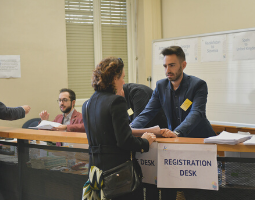



Registrations and Welcome Coffee
EASY Workshop - Plenary Session on ESCI and EASY MO
- ESCI+ developments
- EASY MO Improvements and Updates
- EASY MO Code of Conduct
EASY MO System Parallel Simulations - Part 1
Parallel Workshops Part 1 – choose one among these two:
- EASY MO Application Process: Auditorium
2. BIPs and Digital Learning Agreement: Aula Magna Crispi
Networking with Refreshments
EASY MO System Simulations - Part 2
Parallel Workshops Part 2 – continuation of the simulations:
- EASY MO Application Process: Aula Arte and Aula Insegnanti Crispi (16:30 – 18:00)
2. BIPs and Digital Learning Agreement: Aula Magna Crispi
Parallel Groups
Join one of the following groups:
- Discussion Group: No stupid questions about EASY MO – free discussion on issues encountered in EASY MO (Aula Arte Crispi)
- Workshop on Merge Fields and Letter templates (Auditorium)
- Focus Group on Staff mobility – designing a standard process (Aula Magna Crispi)
Let's celebrate: 10 years of EASY
Have a toast to the 10 years of EASY and have a piece of cake!
Registrations and Welcome Coffee
Pre-Conference Workshops
with Olivier Dubois, The AI App Factory
moderated by Dimitrios Marinos
Artificial Intelligence can offer new opportunities for IRCs of Higher Music Education Institutions to simplify complex workflows, reduce repetitive administrative tasks, improve communication with students and staff, and support data-driven decision making. At the same time, institutions are facing important questions regarding responsible use, reliability, ethical considerations, and the development of institutional guidelines.
This interactive workshop will provide a practical and accessible overview of how AI tools can be integrated into the daily activities of International Relations Offices. Rather than focusing on theoretical discussions alone, the session will emphasize concrete use cases, demonstrations, and real operational challenges identified by participants via the IRC Survey 2026 sent by the AEC to its members during the Spring.
The workshop will explore how AI can support common administrative and communication tasks by creating effective setups tailored to the specific needs of international offices in order to obtain reliable, structured, and high-quality outputs from AI systems.
In addition to operational applications, the workshop will address the growing need for institutional AI policies and ethical frameworks.
The workshop is designed as a collaborative and discussion-oriented session where participants will be encouraged to share their own experiences, challenges, and expectations regarding AI applied to their daily work. By combining demonstrations, practical examples, policy reflections, and peer exchange, the session aims to provide participants with realistic, actionable ideas that can be adapted to different institutional contexts.
Ultimately, the workshop seeks to empower international education professionals to approach AI not as a replacement for human expertise, but as a practical support tool capable of improving efficiency, communication, and innovation within International Relations Offices.
Olivier Dubois is a Luxembourg-based entrepreneur and AI innovation consultant, best known as the founder of The AI App Factory. He focuses on helping entrepreneurs and businesses turn ideas into practical AI-powered applications by combining human expertise with modern AI tools. Through initiatives like Keiko for Business and projects such as Lactose.help, Dubois promotes accessible, pragmatic AI solutions for startups, SMEs, and innovators.
with Sigita Razminovica, Riga, Karolina Jarosz, Krakow and Riccardo Mascia, Parma
Three experienced IRCs of the AEC IRC community will share with their colleagues experiences related to writing BIPs and KA171 projects, which are considered the first step to write more complex applications. This practical workshop is meant for IRCs planning to apply for the first time for BIPs and KA171 looking for information, tips and tricks by fellow colleagues.
Iveri Kekenadze Gustafsson, Malmoe Academy of Music & Lucia Di Cecca, Conservatorio di Musica Santa Cecilia
This advanced workshop is designed for participants with prior experience in international project development who wish to strengthen their capacity to design competitive proposals under Erasmus+ KA220-HED and Horizon Europe Cluster 2. In an increasingly competitive funding landscape, the session focuses on practical strategies for developing strong, coherent, and impactful project proposals aligned with European priorities.
The workshop will cover key stages of project development, including concept design, consortium building, alignment with call priorities, and structuring proposals. Drawing on recent hands-on experience in both Erasmus+ cooperation partnerships and Horizon Europe projects, participants will gain concrete guidance on translating institutional strategies into fundable project ideas.
A central focus of the session will be on award criteria, offering insights into how proposals are assessed, how to interpret requirements effectively, and how to strengthen key sections such as impact, dissemination, and sustainability. Common challenges and frequent pitfalls in proposal writing will also be addressed.
The session will be structured as follows:
- 45 minutes – Erasmus+ KA220-HED: technical aspects, call requirements, and practical examples (Iveri Kekenadze Gustafsson, PhD Researcher in European Studies & Assistant Professor in Socially Engaged Music, Malmö Academy of Music, Lund University)
- 45 minutes – Erasmus+ KA220-HED: award criteria and practical guidance (Lucia Di Cecca, Conservatorio “Santa Cecilia” di Roma)
- 30-minute break
- 1 hour – Horizon Europe Cluster 2: project design, coordination, and consortium management (Iveri Kekenadze Gustafsson)
Through a combination of practical input and discussion, the workshop aims to equip participants with tools to improve the quality, competitiveness, and strategic relevance of their project applications.
With Monica Vejgaard and Alessandra Callegari from the AEC DEI Panel of Experts as well as Steven Faber, AEC DEI Allies.
This three-hour workshop invites International Relations Coordinators at Higher Music Education Institutions to move beyond good intentions and develop intercultural competence as a practised skill. Beginning with a simulation that puts participants in the shoes of the cultural outsider, the workshop builds a shared analytical lens, cultural, institutional, and practical, and applies it to real scenarios through a World Café dialogue format. Rather than offering step-by-step solutions, the session prioritises reflection, peer dialogue, and honest engagement with the assumptions that shape everyday IRC practice. Participants leave with a co-built toolkit of individual and institutional actions, and a concrete personal commitment to carry forward.
Registration Opening with welcome coffee
Introductory Session for Newcomers and Buddy System
In this introductory session Sarah Low, Ivana Mijanovic and Linn Eriksen from the IRC working group will give a short overview of the AEC and IRC activities. The buddy system will be lauched by pairing newcomers with old timers (please register for it in the registration form) and Sabine Roth will present how she can support the work of the IRCs in AEC member institutions in the coming year
Free time for lunch in town
Tour of the Conservatorio
with the Director Calogero Di Liberto
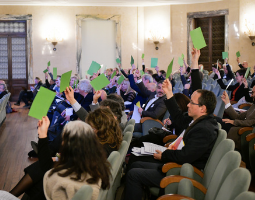
Opening Session
Music performance
Welcome words by
- Francesca Gerosa, Assessore all’istruzione, cultura, per i giovani e per le pari opportunità, Provicia di Trento
- Klaus Broz, Vice-President of Conservatorio di Trento e Riva del Garda
- Calogero Di Liberto, Director of Conservatorio di Trento e Riva del Garda
- Dimitrios Marinos, IRC WG Chair
- Finn Schumacker, AEC Executive Director
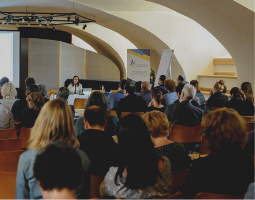
AEC Talk 1 - Building Cross Continental Collaborations
International Collaborations at global level by AEC members – results of the IRC Survey 2026, presentation by Veronika Kuzelova, IRC wg
Case Study: Piano World. Soul Roots Benefits, KA171 Project by Conservatorio di Palermo with India, Nigeria and US, presentation by Consuelo Giglio, IRC at Conservatorio Scarlatti di Palermo, Italy
Q&A moderated by Veronika Kuzelova
Networking with Refreshments
Speed Dating
Meet new colleagues by engaging in themed conversations
Parallel Sessions
with Sara Belfiore, moderated by Ivana Mijanovic, IN.TUNE University Alliance
Session 16:15 – 17:30
Title: Making Joint Educational Offers: First Steps & Benefits
This session presents the 16 joint educational formats developed within the IN.TUNE Alliance, exploring why internationalization in this framework is valuable, how it is implemented, and how it benefits participating institutions, teachers and students. The session highlights the role of International Relations Coordinators (IRCs) as drivers of institutional change, showing how these formats expand institutional offers and provide students with international opportunities beyond traditional full-semester mobility. The session includes in-person participation of teachers who are developing the formats, with the possibility to ask questions and learn first-hand from those who have done them.
Session 17:45 – 19:00 (Going further)
Title: Going Forward: Navigating Joint Educational Offers: Methodology, Implementation and Lessons Learned.
Tailored for institutions offering or developing joint educational offers, this session focuses on the methodology behind the 16 joint educational formats developed within the IN.TUNE Alliance- with a particular focus on joint online courses and joint modules. The session examines the implementation process of the formats, addressing administrative, logistical, and organizational aspects. Featuring insights from teachers representing different disciplines, participants will exchange best practices, discuss lessons learned, and explore strategies to refine and scale similar initiatives. The session includes in-person participation of teachers who are developing the formats, with the possibility to ask questions and exchange with them.
with Olivier Dubois, AI expert, moderated by Dimitrios Marinos
intro and presentation of the IRC Survey 2026 results on AI by Sara Primiterra
Artificial Intelligence offers new opportunities for International Relations Offices in Higher Music Education Institutions to streamline workflows, reduce repetitive tasks, enhance communication, and support more efficient decision-making. At the same time, its use raises important questions regarding reliability, ethics, data protection, and the need for institutional guidelines.
This session will provide a practical introduction to how AI tools can support the daily work of IRCs, focusing on concrete examples, demonstrations, and challenges identified through the AEC IRC Survey 2026. Participants will explore how AI can assist with common administrative and communication tasks, and how effective approaches and workflows can be developed to obtain reliable and useful results.
The session will also briefly address the importance of responsible AI use and institutional frameworks, while encouraging participants to exchange experiences, questions, and good practices. By combining practical examples with peer discussion, the workshop aims to equip international education professionals with realistic ideas for integrating AI as a support tool that enhances efficiency, creativity, and innovation in their everyday work.
Olivier Dubois is a Luxembourg-based entrepreneur and AI innovation consultant, best known as the founder of The AI App Factory. He focuses on helping entrepreneurs and businesses turn ideas into practical AI-powered applications by combining human expertise with modern AI tools. Through initiatives like Keiko for Business and projects such as Lactose.help, Dubois promotes accessible, pragmatic AI solutions for startups, SMEs, and innovators.
Transition into the Profession – aspects/impact of learning environment, internationalisation and curriculum
How far do we concretely support students’ transition into the labour market? This round table explores the added value of exposure for students in Higher Music Education Institutions (HMEIs), across classical, jazz, and popular music fields.
Drawing on the results of the survey conducted by the AEC Education and Profession Working Group on the Transition from Higher Music Education Institutions to Professional Life, the panellists will discuss the most frequently identified needs and challenges faced by students and alumni at this pivotal stage of their careers. The discussion will also examine how mobility opportunities can help address these needs by supporting the development of professional skills, networks, international perspectives, and career opportunities.
During this session, participants will be able to explore in a World Café setting several key questions derived from the main themes and findings of the survey. The discussion will also address disparities between countries in terms of cultural ecosystems, funding structures, and industry access, examining how these factors influence both curricula and career opportunities. By sharing practices from different institutions, the session aims to identify how international experiences can be better embedded into career preparation strategies.
Panellists:
Jan Gerd Krüger – Kielzog (Hoogezand, The Netherlands) – AEC E&P WG
Ema Proso Šepec – Academy of Music, University of Zagreb (Zagreb, Croatia) – AEC E&P WG
Sarra Douik – Student Conservatorio di Musica “Arrigo Pedrollo” (Vicenza, Italy) – Mentee AEC–ECSA–EJN–JMI Mentorship Programme
Oana Balan-Budoiu – Academia Națională de Muzică, “Gheorghe Dima” (Cluj-Napoca, Romania) – AEC E&P WG
introduced by Sarah Low, IRC wg
Olha Dolhopolova and Natalia Kulak, Ukrainian students studying in Trento, Bohdan Rumiantsev, IRC at the Ukrainian National Tchaikovsky Academy of Music, Kiev and Tatiana Sovhyra, Kiev National University of Culture and Arts, moderated by Calogero Di Liberto, Director of Trento Conservatoire
moderated by Anika Stiawa, Graz/IRC WG with Sigita Razminovica, Riga, Karolina Jarosz, Krakow and Riccardo Mascia, Parma/IRC WG
case study presented by Susanne Van Els, Lyon/Hamburg, with Monica Vejgaard and Steven Faber
Safety frameworks, codes of conduct, and institutional rules are rarely as universal as they appear. This session brings together International Relations Coordinators and DEI practitioners to explore what happens when the assumptions behind a “safe space” intersect with the diverse cultural frameworks students bring with them. Drawing on concrete experience from conservatoire practice, including the particular complexity of highly international, multi-institutional programmes, the session explores how the same rule can carry entirely different legitimacy depending on who is reading it, and why group dynamics tools designed to foster inclusion can themselves carry cultural assumptions. Through case scenarios and practitioner dialogue, participants are invited to reframe the IRC role not only as rule enforcement, but as cultural mediation of safety. No prior attendance at Thursday’s workshop is required.
Parallel Sessions - REPEATED
See above for topics, abstracts and locations
Concert of the AEC BIP Orchestra and Choir Trento
I – Allegro moderato
II – Andante con moto
III – Rondo. Vivacepf. Tommaso DalpiazAntonio Vivaldi – Gloria in D major RV 589
I – Gloria in excelsis Deo, Allegro (Coro)
II – Et in terra pax hominibus, Andante (Coro)
III – Laudamus te, Allegro (Soprano I e II)
IV – Gratias agimus tibi – Propter magnam gloriam,allegro (Coro)
V – Domine Deus, largo (Soprano I)
VI – Domine Fili Unigenite, allegro (Coro)
VII – Domine Deus, Agnus Dei, adagio (Contralto e Coro)
VIII – Qui tollis peccata mundi, adagio (Coro)
IX – Qui sedes ad dextram Patris, allegro (Contralto)
X – Quoniam tu solus Sanctus, allegro (Coro)
XI – Cum Sancto Spiritu, allegro (Coro)Soprano I, Lucrezia Masia
Soprano II, Iris Kißner
Mezzosoprano, Eva Maria Ruggeri
oboe, Beatrice ZanonAEC BIP Choir Trento 2026
dir. Salvatore La RosaAEC BIP Orchestra Trento 2026
dir, Andrea Raffanini
Welcome Dinner
Registration continues - Guided Tour of the Conservatoire
AEC Talk 2 - Going Global
| Music introduction
The AEC Global Strategy, presentation by Finn Schumacker, AEC Director
Going Global – how to prepare for critical situations? Adam Lipski, Frankfurt University of Applied Science Q&A moderated by Dimitrios Marinos, IRC wg
As higher music education institutions continue to expand their international activities, IRCs operate within a rapidly changing and uncertain global environment. Political instability, armed conflicts, public health threats, travel disruptions, rising costs, and evolving security concerns directly affect the organisation of international mobility for students and staff. International Relations Offices are therefore required not only to facilitate mobility, but also to anticipate risks, support travellers, and ensure institutional resilience.
Adam Lipski is a senior internationalization and mobility professional at the Frankfurt University of Applied Sciences, working primarily within the International Office. He is heading the unit International Compliance, which coordinates matters of Mobility Safety, Dual-Use and Knowledge Security. In that function, he serves as one of the university’s key Safety Managers for Global Mobility, where he is involved in risk assessment, duty of care, and crisis response for student and staff mobility. This includes managing procedures related to travel safety and institutional risk management for international exchanges and stays abroad. His work sits at the intersection of mobility management and internationalisation strategy, with a strong emphasis on ensuring that international academic exchanges are not only expanded, but also compliant, safe, and operationally resilient. He has also contributed to institutional efforts to develop structured compliance systems for international cooperation and mobility governance. |
ESCI+ udpates and Information Forum
| Updates on ESCI+ by Sara Primiterra
Information Forum – pitches on future projects (2 min per presentations, apply for it in the Registration Form) |
Information Market on past and new projects
Information Market on dissemination of ongoing/completed projects and new projects (with posters)
Match Making
Find your project partner – please pre-arrange your meeting via the Swapcard App
Networking Lunch
Discussion Groups
Join a free discussion on Erasmus, share your questions and doubts, even the most “stupid” ones within a safe space moderated by Veronika Kuzelova and Ivana Mijanović, IRC working group
Discussion with students: Kejsi Çoku and Ebi Çoku, students from Albania / KUG Graz, and Olha Dolhopolova and Natalia Kulak, Ukrainian students studying in Trento, moderated by Iveri Kekenadze Gustaffson former member of the EPASA board, IRC in Malmoe, Sweden, phd student, member of the IRC working group
NB: this session is NOT repeated on Saturday
This session, focused on the point of view of students coming from EU Enlargement countries, is meant to establish a dialogue with students from Ukraine and Albania on challenges, integration, financial support and job perspective. The discussion is initiated and moderated by Iveri, who is writing his phd thesis on EU enlargement. The floor will be open to participants of the conference.
Groups discussions on mobility-related topics introduced and moderated by Sara Primiterra and Riccardo Mascia
NB: this session is NOT repeated on Saturday
discussion moderated by Ashkhen Fixova, manager of the AEC network of Green Officers
Are the HME institutions equipped with policies that support greener options? How is it possible to promote more sustainable travel practices across the AEC members? And how can we, as individuals and as a sector, make greener choices a realistic and accessible option rather than an exception?
As environmental awareness grows across the higher music education sector, questions around sustainable travel are becoming increasingly relevant, yet the gap between intention and practice remains significant in many institutions.
This session will explore the challenges of low-carbon travel, share the best examples already implemented by individual institutions, and examine how the AEC — and in particular its newly established Network of Green Officers — can contribute to promoting environmentally friendly travel practices across the sector.
A central thread running through the discussion is the question of what hinders greener travel, whether structural, financial, cultural or logistical, and what role students play in pushing for change or shaping institutional priorities. Participants are encouraged to draw on concrete experiences from their own contexts, including cases where green travel policies exist on paper but struggle to take hold in practice. Useful and practical tools and resources on green travel will also be shared for participants to bring back to their institutions and use in their daily work.
Anyone with an interest in the green shift, low- carbon mobility and sustainability at large is welcome to join.
Introduction to the topic by Raul Giancarlo Maria Masu, professor of electronic music in Trento Conservatoire, discussion moderated by Dimitrios Marinos
On the one hand, AI in music education offers significant opportunities (real-time feedback, personalized learning, democratized (?) composition). On the other hand, recent research identifies critical challenges: AI models function as “black boxes” without explaining musical choices; datasets can and often are biased; while AI can support and speed up creative processes, it may stifle individuals’ creative confidence. The EU classifies educational AI as “high-risk,” prohibiting emotion-recognition systems in schools as well as discouraging Ai for grading. Overall, hybrid models – achieved by combining AI analysis with human instruction – arguably, provide maximum educational value, ensuring technology enhances rather than replaces the human dimension of music making.
Networking Activity
| Trip to Riva del Garda
Tour of Riva Conservatoire Site + Boat trip on Garda Lake – 200 people maximum (only registered participants) Please check on your badge to which group you belong to and join the relevant bus (A-B-C-D) and boat tour shift (1 or 2)
No food or drinks available on the boat, please buy refreshments before or after the boat trip
|
AEC Talk 3 - Focus on Enlargement Countries
Higher Music Education in EU Enlargement Countries: Cooperation, Resilience and Artistic Freedom
What does EU enlargement mean for higher music education institutions, musicians and artistic communities in countries where the European integration process has become increasingly uncertain?
In this keynote, Ivana Perkovic reflects on the experience of higher music education in Serbia, examining how political and institutional developments affect music academies, students, teachers and opportunities for international artistic cooperation. The session will consider the role of music institutions not only as educational organisations, but also as spaces for artistic freedom, critical reflection and civic engagement.
Particular attention will be given to participation in European initiatives such as the IN.TUNE alliance, which represents one of the most tangible forms of European integration available to higher music education institutions in Serbia. The keynote will explore how such cooperation can support artistic exchange, curriculum development, institutional resilience and a sense of belonging to a shared European music community, while also considering its vulnerability when domestic political conditions move in the opposite direction.
The session will conclude by asking how European higher music education institutions and networks can provide meaningful, sustainable and reciprocal support to colleagues working in politically and institutionally challenging contexts.
Keynote speaker: Ivana Perkovic, Professor and Head of the Department of Musicology, Faculty of Music, University of Arts in Belgrade
Moderator: Iveri Kekenadze Gustafsson, Lecturer in Socially Engaged Music and PhD Researcher in European Studies, specialising in EU enlargement, Lund University; member of the AEC IRC Working Group.
Networking with Refreshments
Discussion Groups - repeated and mixed
Introduction to the topic by Raul Giancarlo Maria Masu, professor of electronic music in Trento Conservatoire, discussion moderated by Dimitrios Marinos
On the one hand, AI in music education offers significant opportunities (real-time feedback, personalized learning, democratized (?) composition). On the other hand, recent research identifies critical challenges: AI models function as “black boxes” without explaining musical choices; datasets can and often are biased; while AI can support and speed up creative processes, it may stifle individuals’ creative confidence. The EU classifies educational AI as “high-risk,” prohibiting emotion-recognition systems in schools as well as discouraging Ai for grading. Overall, hybrid models – achieved by combining AI analysis with human instruction – arguably, provide maximum educational value, ensuring technology enhances rather than replaces the human dimension of music making.
Join a free discussion on Erasmus, share your questions and doubts, even the most “stupid” ones within a safe space moderated by Veronika Kuzelova and Ivana Mijanović, IRC working group
Groups discussions on mobility-related topics introduced and moderated by Sara Primiterra and Riccardo Mascia
introduction and moderation by Finn Schumacker and Alessandra Callegari, AEC Office
Transnational Academic Networks in Times of Political Turmoil
Resilience, responsibility, and the role of Higher Music Education in divided societies
While the keynotes deliverd by Adam Lipski and Ivana Perkovic, focused more on the options and responsibilities of individual institutions when facing challenging situations, this session will instead explore how institutions can act collectively, and how we build a common understanding on behalf of the wider community. This includes finding answers to difficult questions like: how do we create a shared vocabulary and navigate
between neutrality and engagement, between artistic mission and political responsibility. And – if at all possible – how do we give space to individual voices, at both institutional and personal levels?
moderated by Steven Faber
The AEC Safe & Brave Spaces:
- Provide a confidential and moderated environment where participants can speak freely about their experiences at the event and within their home institutions.
- Focus on themes such as diversity, equity, inclusion, accessibility, gender equality, and non-discrimination.
- Encourage participants to reflect on power relations, discrimination, and institutional culture in higher music education.
- Are facilitated by members of the AEC’s DEI Allies network / Gender Equality and Non-Discrimination Task Force, ensuring a respectful and structured dialogue.
- Serve as a channel for collecting feedback that informs AEC policy and future event design, helping improve inclusion and safety across the network.
Alongside these sessions, please enjoy the Quiet Room, which is a separate space for participants who need rest, calm, or sensory downtime away from the programme
Reflection on the event and proposals for future edition by participants moderated by Sarah Low and Linn Eriksen IRC wg
Reflection on the event and proposals for future edition by participants moderated by Anika Stiawa and Iveri Kekenadze Gustafsson
Closing Session
| – News from Finn Schumacker, AEC Director
– Announcement of the next IRCs Meeting location and dates – Closing Remarks by Riccardo Ceni, AEC Council |
Share your Food and Drinks
Bring typical food and drinks from your country and share them with your colleagues. Glasses, plates and cutterlies will be available on the spot.